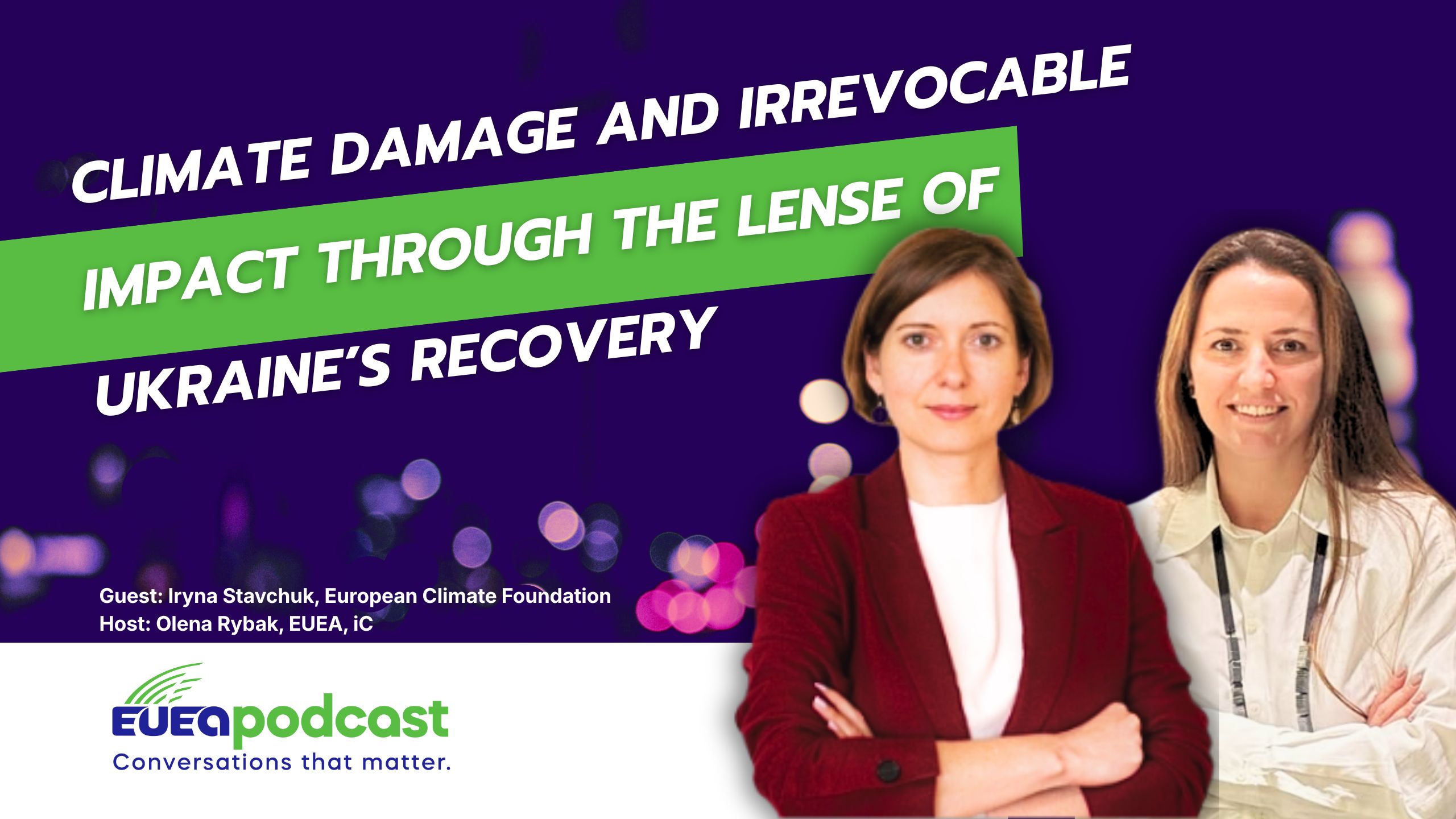
Podcast with Iryna Stavchuk, Program Coordinator at the European Climate Foundation (ECF).
Podcast host – Olena Rybak, Deputy Chair of the Board of the European-Ukrainian Energy Agency, Executive Director of iC consulenten in Ukraine.
The European Climate Foundation (ECF) is well known for its activities in the field of climate initiatives. Tell us about the organization’s mission, its operation globally and in Ukraine.
— The ECF is the largest private philanthropic organization working on climate change. Its mission is to support a wide range of initiatives contributing to the development of climate policies, public engagement, and the buildup of political will to implement relevant measures. It also encompasses initiatives targeting the general public, such as educational programmes and other projects that help people to play active role in addressing climate change.
The ECF was established more than 15 years ago following a critical stage of failure of the international climate negotiations in Copenhagen.
Philanthropic organizations are charitable foundations established by large corporations, big family-owned businesses, or private individuals who possess substantial resources and strong awareness of the need to act. T world has no time to wait, action is required now, as the climate situation continues to deteriorate, and the time left to contain global warming within the 1.5–2°C threshold is rapidly shrinking.
For this reason, these foundations created an organization that pools financial resources and develops strategies to ensure their most effective use. If each foundation or wealthy individual were to act independently, efforts would risk being fragmented and inefficient, with some focusing narrowly on a single sector or country. Effective climate action, by contrast, requires coordinated efforts across all sectors and countries, strengthening initiatives that currently ensure reduction of greenhouse gas emissions and other essential measures.
Which international projects and initiatives can you tell us about?
— Actually, when these initiatives were being established, foundations were created on all continents. The European Climate Foundation (ECF) operates in Europe, and climate foundations are also present in other parts of the world. Our work covers most key areas, including energy, transport, industry, land use and agriculture, buildings, financial instruments, as well as global climate diplomacy and negotiations.
In addition, there are numerous platforms and initiatives that were established with active assistance of the Foundation. For example, the 2050 Platform is a tool that supports developing countries in designing long-term climate strategies and identifying pathways to reduce greenhouse gas emissions.
There is also the Forum for a New Economy initiative, which focuses on the theoretical and economic dimensions of modern approaches to addressing climate challenges. It analyses the shortcomings of existing economic models and develops approaches to transforming economies to maintain their effectiveness for people while ensuring sustainability in the context of long-term environmental challenges.
So, do you work primarily at the policy level — institutional engagement and capacity-building? Or do you also support “on-the-ground” projects?
— We do support “on-the-ground” projects, and we also invest significantly in strategic communications. Without this work, it is impossible to build public support for policies and motivate politicians to implement them. In practice, this means working with the public and various political stakeholders so that complex reforms — which are difficult to introduce even in Europe — are integrated into political agendas and actually carried through to implementation.
In Ukraine, we sometimes have the impression that in Europe everything happens automatically: politicians are responsible, decisions are madeeasily, and funding is allocated as a matter of course. In reality, intense internal political struggle is ongoing.
Behind every decision lies the work of numerous organisations, activists, members of parliament, and public representatives who fight to uphold democratic principles and to ensure that policymakers move forward in response to the real needs of society.
This is a constant internal struggle that often remains invisible. We only hear that “Europe has adopted the Green Deal” or that “Europe has adopted another policy,” but behind these outcomes lies enormous, day-to-day work.
If it is not so easy to implement climate solutions even in Europe, what does the work in Ukraine look like? Did the Foundation operate here before the full-scale invasion?
— Prior to the full-scale invasion, there was only one project in the energy sector in Ukraine, that is, the ECF was not operating in the country on a broader scale. When the invasion began, the Board and the organisation became actively involved in short-term support: funds were allocated to Ukrainian activists and experts in Europe so that they could partially continue their work for Ukraine, as back then, the expectation was that the war would end quickly.
Once it became clear that the war would not conclude in the near term, a full-fledged programme was launched. Since the summer of 2022, work has begun on developing a strategy to define in a systematic and strategic way what the Foundation could do in Ukraine. Initially, the focus was on the concept of destroyed territories reconstruction using low-carbon technologies and modern approaches to recycling and reusing construction materials.
However, the strategy evolved: the agenda is no longer centred solely on the complete rebuilding of cities. The Foundation’s activities are now focused on measures that support Ukraine here and now — in terms of energy security, policy development, and specific actions that help Ukrainians withstand extremely difficult times and support the country’s European integration. The emphasis is on solutions that combine sectoral transformation with new approaches, while being immediately relevant and practically useful.
How is funding allocated in Ukraine? Do your donors determine which green recovery sectors they want to channel their funds into, or is there a global funding pool from which the ECF itself sets priority sectors?
— It is a hybrid model. Some of our donors provide funding linked to specific strategic priorities, and in these cases, we effectively act as a re-granting organisation. Other philanthropists provide funds directly to the ECF, allowing the organisation to independently direct resources to the areas, strategies, and activities it considers most relevant — and this is how the majority of our funding is structured.
This is the most effective model of cooperation, as both the situation on the ground and strategic priorities change frequently. This flexibility allows us to respond quickly to emerging needs, context shifts, and evolving challenges. There are donors who are interested in particular regions or thematic areas, but this does not involve promoting specific technologies or solutions. We have strict ethical policies and standards governing from whom and in what manner the organisation accepts funding.
Until now, Ukraine has been included in these flexible funding mechanisms, allowing us to independently define priorities, develop our strategy, and direct resources to where they are most needed.
Please tell us in which areas the funds have been directed over the past three years and what has been supported. Could you share some examples of interesting initiatives?
— We set several strategic objectives. The first was to ensure that government decisions on reconstruction take into account long-term considerations and their impact on reducing greenhouse gas emissions. Reconstruction is already underway, and investment decisions are being made, while state policy on reducing dependence on fossil fuels remains insufficiently formulated. For this reason, we conducted analytical research to outline the necessary solutions and policy frameworks, moreover, we supported the coordination of civil society organisations, their participation in decision-making processes, and drafting of comments and position papers to ensure that government decisions are transparent, effective, and aligned with current climate considerations.
Besides, we support organisations working in specific sectors, including energy, transport, and buildings. It is essential that new buildings are energy-efficient and integrate economically viable renewable energy solutions, thus reducing communities’ future dependence on fossil fuels. In parallel, we work at the local level – testing pilot solutions and measures that can be implemented immediately and later advocated for at the national level.
We support communities’ capacity-building, organise study visits to Eastern European countries, and implement pilot projects, including preliminary feasibility studies for renewable energy facilities at critical infrastructure sites, transport mobility planning, and other practical solutions aimed at identifying barriers and strengthening national-level advocacy.
Transformation of the energy sector is also our area of activities. Our objective is to help Ukraine accelerate the development of decentralised renewable energy sources as part of the broader transition of the entire sector towards low-carbon solutions.
Who are your partners in this work on the Ukrainian side – the Ministry of Energy or primarily local-level partners?
— We work with a wide range of partners. These include civil society organisations that help local communities prepare their first renewable energy projects, such as installing solar power systems at water utilities or hospitals, and securing the necessary funding. We provide advisory and technical support, while our partners arrange financing for construction and equipment.
Many humanitarian organisations have also become involved in these areas, and some private companies implement such initiatives as part of their corporate social responsibility programmes.
At the beginning of the war, we proposed to the Ministry of Energy to consider renewable energy sources, alongside the search for generators, as a pathway for diversifying energy supply. Back then, renewable energy was seen as costly and not well understood.
Today, however, all stakeholders are engaged, and projects are being implemented and delivered at the local level.
Business associations are our partners, as businesses are increasingly interested in technologies and renewable energy solutions for their own operational needs.
We supported specialised training programmes for new professionals in the renewable energy sector.
The “Repower” project is developing a systemic programme in two regions, bringing together state employment centres, vocational schools, educational institutions, and businesses to establish more than just a series of one-off trainings, but a high-quality, structured reskilling system that can drive long-term, systemic change.
How broad is the range of initiatives you have supported in Ukraine over these years? Do short-term projects also fall within this scope?
— Each year we support around 60 initiatives, ranging from small, short-term projects to large-scale programmes. The largest project we have supported is the work of the Secretariat of the High-Level Working Group on Environmental Issues, which cooperated closely with the Office of the President of Ukraine. International policymakers took part in this work, including Margot Wallström, Mary Robinson, as well as climate activist Greta Thunberg.
The work covered three core areas: documenting the environmental impacts of the war, international political efforts to ensure Russia’s accountability for environmental damage, and supporting Ukraine within the framework of a “green” reconstruction.
The outcome of this work was the Environmental Compact document, which consolidated key recommendations across these three areas and now serves as a roadmap for international organisations and policy documents related to the peace formula and compensation for environmental damage. This work contributes to processes that, we hope, will be implemented in Ukraine.
There are few organisations in Ukraine that provide small and medium-sized grants. How can organisations, especially local ones, approach you? Do you primarily focus on civil society and the NGO sector, or do you also work with other partners?
— Our partners are primarily civil society organisations and research centres. Occasionally, we work with consultants for specific tasks, but we mostly collaborate with organisations that generate knowledge and build expertise in their respective fields.
As for how to engage with us, we do not operate through open calls for proposals like many foundations. Instead, we develop strategic priorities based on analysis of the political context and Ukraine’s needs, define objectives and tasks, and then select partners who are active in those areas.
We maintain ongoing communication with our partners, monitor developments in the country, and jointly assess existing gaps — whether in knowledge, capacity, or communication resources. If the issue is not the policy itself but its implementation or stakeholder understanding, we initiate targeted projects to address these challenges.
Organisations can reach out to us directly — the contact email is available on ECF website. We always review proposals and proceed with those relevant to the current context. In some cases, we proactively approach organisations having the necessary technical or analytical expertise to conduct assessments and help mobilise additional partners in order to move specific policy areas towards implementation.
Can you support a new idea in the field of “green” reconstruction at an early stage? What areas could this involve — transport, buildings, waste management?
— Waste management receives less focus. This year, we provided some support in this area: a study visit to the Czech Republic was organised for representatives of local and national authorities, civil society organisations, and businesses to observe how the system works there. It was very valuable experience, as in Ukraine there is often an attempt to transform the solutions without understanding how these systems have long been functioning in the EU, where the Directive on construction waste recycling has been in place for over ten years. Unfortunately, next year we will have less resources available for this area.
How do you assess the capacity of your potential partners at the moment: are there already enough high-quality proposals to choose from, or do you have more resources than compelling ideas and projects?
— The main organisations in Ukraine that have been active for many years have a clear understanding of what they want to achieve and are able to submit high-quality proposals — that experience exists. The challenge lies in determining which tactics or strategies will be most effective in driving change, and where time and resources can be invested most efficiently. When organisations are not part of the government and do not have access to all relevant information, a significant portion of work must go into building relationships. Sometimes it is difficult to select the right focus because the objectives can be very ambitious, making project implementation challenging for everyone involved.
Smaller organisations often expect that foundations will support any good idea at the local level. However, for a foundation, it is crucial that every activity is grounded in a theory of change: how this activity will lead to tangible changes in the country. Some donors support purely local initiatives, but our expectation is different — there must be a clear theory of change.
For example, if we support research on solar energy at water utilities, we understand that proven economic benefits can have an impact at the national level: the information spreads, case studies are generated, communications are engaged, and results are multiplied.
All of our projects include a “theory of change” section in the proposal, which makes the projects more effective. For instance, in training programmes for veterans, applying the theory of change led to the idea to implement the trainings in collaboration with the Employment Fund. Significant barriers were identified: the Fund cannot simply contract with any vocational school; the course must be delivered within the Fund itself. Projects like these allow us to identify obstacles and drive systemic change.
Now, working in the NGO sector, how do you see Ukraine’s progress in the climate sphere compared to the period when you were a Deputy Minister of Environmental Protection and Natural Resources of Ukraine from 2020 to 2022? Do you see positive developments?
— I have been working in the field of climate change since 2006. In Ukraine, this area has never been a top priority; there have always been other pressing issues and many arguments for why action could not be taken, especially in political debates with industry and energy stakeholders.
At the same time, over all these years it has been clear that climate solutions are not solely the prerogative of wealthy countries. They can always be broken down into simple, actionable steps, which, in fact, the country should implement across all sectors. These measures improve quality of life and make the country modernized and efficient through energy efficiency, the development of renewable energy, better buildings, transport planning, investment in public transport, and waste management. Climate action acts as an overarching framework, bringing together all these essential measures.
At any stage of the country’s development, we can identify a set of priority actions that are immediately cost-effective and relevant. I have always approached it pragmatically rather than ideologically — taking what can and should be implemented now, and doing it.
During the war, I see two main trends. The first is a boom in decentralised energy, as for both individuals and businesses this is a matter of energy security, so everyone does what they can. Initially, mayors were sceptical about renewable energy projects, but once they see budget savings in the first year after implementation, they become enthusiastic about expanding renewable projects within municipal enterprises. The challenge is to integrate this into a sustainable framework, avoiding distortions, for example, in solar power stations construction. I believe this is technically feasible, provided there is the right state policy.
The second trend is a decline in capacity at all levels. When I worked in the Ministry, the personnel shortage was already obvious. We did not even have a state agency responsible for implementing regulations and laws, training communities and businesses, and supporting project implementation. Today, that capacity is even more limited. The entire Ministry was completely dissolved, with only some staff transferred to the Ministry of Economy.
I understand that the ministries were merged to optimise processes. How has this affected the environmental sector in the country?
— There has been no real optimisation. Experience shows that environmental issues tend to be sidelined in favour of the priorities of the more powerful ministry. The Ministry of Environmental Protection and Natural Resources needs to be reinstated, because EU integration packages in the environmental sphere require significant work, qualified personnel, and proper implementation. Without these, they simply cannot be carried out.
If you were currently in the Ministry and had the capacity to act, what priorities and changes in Ukraine would be most important for you?
— The Ministry has a wide range of priorities, but if we group them, the priority area would be establishing processes to document the environmental impacts of the war, so that this information can be used later in registries, court proceedings, and to enable compensation claims from Russia.
The second priority would be establishing an up-to-date environmental policy: ensuring inspections prevent the destruction of small rivers, preventing unethical companies from abusing environmental impact assessments during wartime, and making sure environmental processes function effectively.
The third priority is EU integration. This is strategic for the survival of the state. It requires systematic legal work, which must be prioritised and actively advanced.