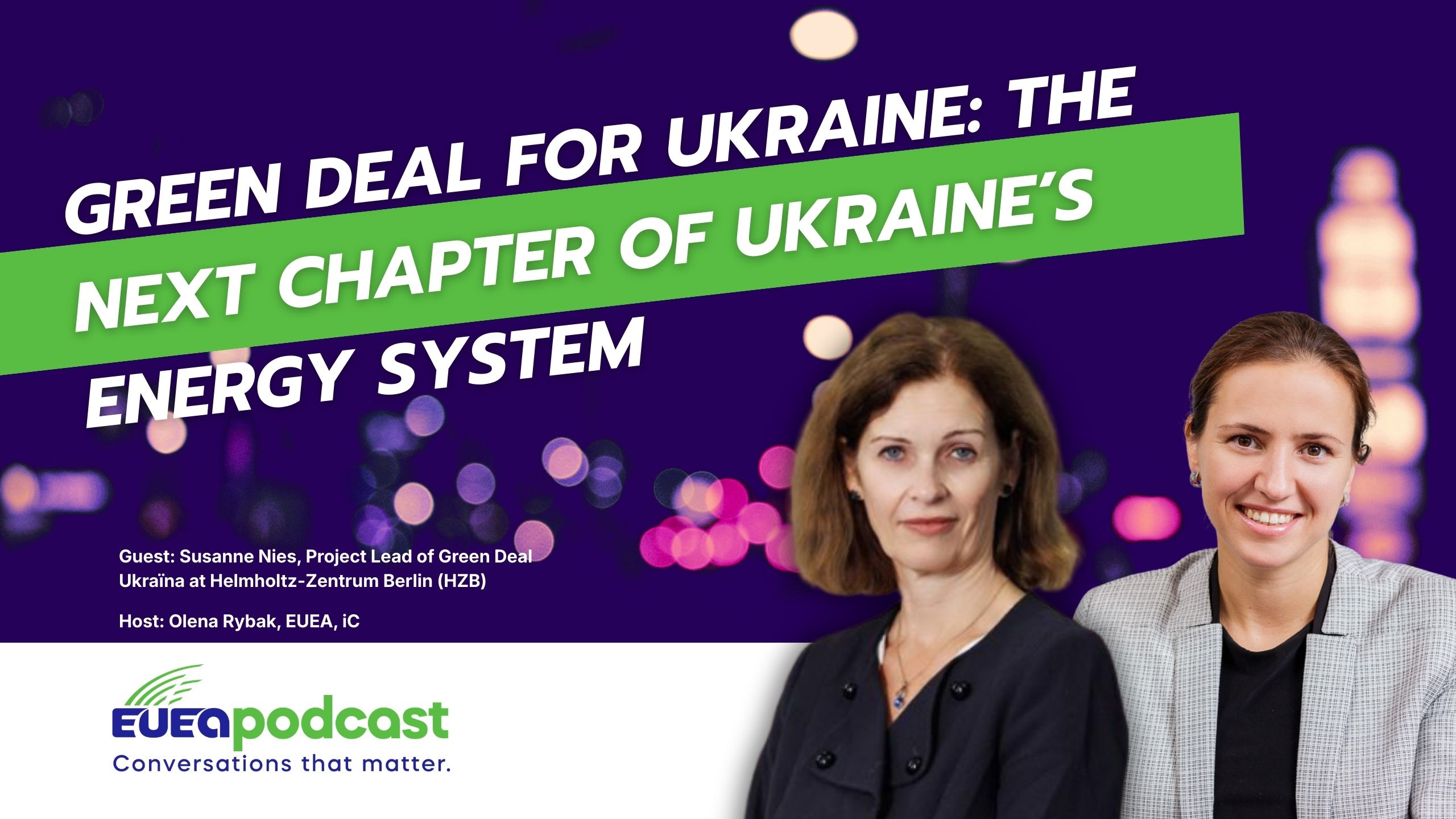
Podcast with Susanne Nies, Project Lead of Green Deal Ukraїna at Helmholtz-Zentrum Berlin.
Podcast Host – Olena Rybak, Vice-Chair of the Board of the European-Ukrainian Energy Agency, Managing Director of iC consulenten in Ukraine.
Could you tell us about the Green Deal Ukraїna project, its objectives and core activities?
— The Green Deal Ukraїna project was launched about a year after the beginning of the full-scale war. From the very beginning it was designed as a trilateral initiative between Ukraine, Poland and Germany. We believe that the future European architecture will include Ukraine as a full member of the European Union and as part of the democratic Western Bloc, and therefore cooperation between these countries is essential.
Germany in the past made a number of strategic mistakes, focusing almost exclusively on Russia through what was often described as a “Russia-first” policy. Today this approach is changing. German leadership has declared a Zeitenwende — a historic turning point — which means that Germany has turned from a Russia first policy towards cooperation with the countries between Germany and Russia, including Ukraine and Poland.
The project itself is funded by the German Federal Ministry of Research, Technology and Space and is implemented within Helmholtz-Zentrum Berlin, a large research institution with around 1,200 staff. Helmholtz works on a wide range of topics, including batteries, hydrogen technologies, photovoltaic systems, synchrotron research, and energy modelling.
Within this structure, the Ukraine project has become one of the most visible initiatives. Our work focuses primarily on data analysis and modelling of Ukraine’s energy system. This is challenging because during wartime reliable data is limited. We work with institutions such as Ukrenergo under confidentiality agreements to obtain and analyse data related to the energy system, supply and demand, and regional dynamics.
In addition to modelling and research, we produce policy papers on topics such as electricity interconnections, market coupling with the European energy system and the deployment of innovative energy technologies. These papers are prepared in close coordination with Ukrainian ministries, the European Commission, the German and Polish governments, as well as Ukrainian stakeholders and NGOs.
Another crucial pillar of the project is capacity building. Ukraine will need a new generation of energy sector leaders who understand both modern technologies and the European regulatory environment. Our goal is to contribute modestly to developing that capacity.
You mentioned capacity challenges across the sector. From your perspective, where do the biggest gaps lie — at the technical, institutional, or political level?
— The challenges are clearly visible across the sector, including from the perspective of companies. For EPC contractors — engineering, procurement and construction — assembling competent teams for installations and reconstruction projects is already a major issue.
There are multiple reasons for this. Many professionals are on the front line, many have left the country, and the available workforce is significantly reduced.
At the same time, there is another important challenge beyond workforce availability. Public administration, particularly ministries, cannot offer competitive salaries. Even when professionals are trained for these roles, salaries often do not meet basic needs, which makes it difficult to attract and retain talent.
Overall, the capacity gap is not limited to one area — it exists across the entire energy sector. Skilled professionals are needed for implementation, regulatory work, decision-making, and research.
With more than 18 years of experience in the European energy sector, it is also clear that the industry tends to be quite conservative, with decision-makers often focused on existing systems. This makes it important to bring in a new generation of professionals ready to take ownership.
In this context, Ukraine is already showing strong potential.
Are you currently offering education programmes or workshops, and which areas have you focused on so far?
— Since 2023 we have implemented two main types of training programmes.
The first focuses on local communities. These trainings help municipalities understand what energy planning means in practice: how to develop local energy strategies, how to plan investments, and how to access financing for energy projects.
The second category targets national-level decision-makers. We have already trained around 400 participants from institutions such as the energy regulator, Ukrenergo, the Ministry of Energy and other government bodies. These programmes aim to strengthen their understanding of European legislation, electricity market functioning and energy system operation.
We conduct these trainings in cooperation with the Florence School of Regulation and several other partners.
In addition, we recently launched a new initiative together with the National University of Kyiv-Mohyla Academy. We established a Kyiv Energy and Climate Lab which will focus on research, data modelling and education. The lab will also develop a new master’s programme in Energy and Climate.
This programme is designed not only for university students but also for professionals already working in the sector. We are exploring formats such as evening and weekend courses so that people can combine education with their professional responsibilities.
What do you observe among Ukrainian students and young professionals? Is there strong interest in the energy sector?
— There is a huge interest, and that’s quite impressive. The interest in being part of the energy world is very high, while the educational offer is very limited. From the beginning, this gap was clear.
Twice as many people applied to our courses than we could accept. Around 50% of applicants had to be refused, assessing them by the potential impact they could make. The goal was not just to train the next generation of professors — that’s important too — but to train the next generation of leaders, those who make decisions.
This is an excellent project. Looking forward to seeing some of the graduates in the future.
Expanding to Ukraine’s energy sector as a whole, this is one of the core areas where the Green Deal Ukraїna project operates.
What do you see right now as the main challenges in the energy sector for the next few years? Could you name a few priorities?
— The challenges are huge. Ukraine’s energy system was somewhat Soviet-style overbuilt, similar to what Western countries had before liberalization. Infrastructure was doubled, power plants overbuilt — typical behavior in administration: “Let me sleep well at night. Let me build extra.”
This overcapacity helped the country survive the first unexpected attacks. During the first winter, Russia aimed to hit infrastructure, and now the goal seems to be creating a humanitarian disaster, like last winter.
Ukraine has learned a lot — how to repair and protect infrastructure under extreme conditions. Protection measures were insufficient at first, and assets were heavily damaged.
Another major challenge is corruption: decision-makers have not always played the right game, frustrating those working hard to do things properly. Some progress has been made, but it remains crucial to address.
Ukraine has many assets to tackle future problems, but also many challenges still to solve. That’s the current situation.
At the beginning of the war, Ukraine managed to interconnect with the European electricity system, which proved to be a crucial lifeline. Are import capacities now fully utilized, or are there still ongoing efforts to increase them? How is that progressing?
Several elements are important here. First, full credit goes to the team at Ukrenergo in February–March 2022: Volodymyr Kudritsky, Vitaliy Zaychenko, Oleksiy Brecht, Mariia Tsaturian and the others. Their leadership was incredible and saved thousands, maybe even millions, of lives. Everyone should be proud of these heroes.
In winter, Ukraine’s peak load is 18 GW, in summer around 14GW, while installed capacity is 11 GW. Import capacity this winter is 2.45 GW, which is a substantial part of what is needed, even if not fully used. There is room for more, and Ukraine is fortunate to have five strong interconnections, unlike the Baltics, which effectively operate as an island. Good news is that now with the spring the solar capacity (PV) comes back: Ukraine has 3 GW of PV installed.
Two main projects need a boost: the Kapušany project to Slovakia and the Isaccea project to Romania. Together, these would add 2 GW of import capacity, potentially increasing capacity by at least 50%. Export capacity is equally important, as Ukraine is positioning itself as an energy hub and could become a transit or production center in the future.
Technology improvements could add more. For example, the Polish–Ukrainian line suffers from technical impedance.
Adding FACTS (Flexible AC Transmission System) devices could provide an extra 500 MW, but deployment is still slow and frustrating, even though it could be done in a few months.
Can you clarify what market coupling means and its potential effects on Ukraine’s energy sector? Is the system technically and structurally ready?
– Market coupling integrates Ukraine into the European single electricity market, similar to the EU single market for goods and services. It applies to electricity and gas, which depend on networks, unlike oil. Before market coupling, countries had vastly different electricity prices—for example, one country at 100, another at 20, another at 50.
Market coupling enables cross-border trading, creating competition, aligning prices, and ensuring power flows efficiently according to demand.
Ukraine is formally part of the EU integration process. In June, the country must apply to the Market Coupling Steering Committee (MCSC), which initiates a detailed, year-long integration process, including technical and regulatory steps. Completion of this process will allow Ukraine to participate fully in the European market.
Challenges in Ukraine include an under-functioning electricity market and price caps that prevent prices from reflecting scarcity, which discourages investment. Public Service Obligations (PSOs) keep companies dependent on subsidies, rather than allowing them to operate competitively. Cultural habits from the post-Soviet era, such as expecting free electricity or water, further complicate the transition. Targeted support for vulnerable consumers is necessary, while high-income users should not receive subsidies.
Resistance from some market participants may also slow progress. Certain Ukrainian companies may oppose competition from Poland, and vice versa. Neighboring countries, such as Slovakia, are concerned that Ukraine’s electricity demand could temporarily increase their domestic prices, as occurred in France and Belgium in winter.
Effective market coupling must balance these dynamics, requiring active coordination from decision-makers, governments, and EU institutions.
Investment in new generation should rely on market signals, supported by a mix of private investment and targeted public support. Subsidizing entire capacity projects, such as the 9.5 GW suggested by Vitaliy Zaychenko (Ukrenergo), would be inefficient; the market should determine where and what capacity is needed. Additional de-risking measures, particularly in frontline zones, are essential to attract private investment.
Ukraine’s legislative framework is another critical factor. The electricity integration package has been delayed in parliament for two years and remains unapproved, despite being scheduled for December 2024. Approval is a precondition for the formal application to the MCSC and for full market coupling. Without functional market mechanisms and completed legislation, Ukraine cannot fully benefit from the integration.
Once market coupling is implemented, Ukraine will gain access to cross-border electricity flows, more competitive prices, and alignment with European market rules. It will also enable Ukraine to function as a regional energy hub, supporting domestic needs while facilitating electricity trade across Europe.
What changes or effects has CIBAM’s implementation in January brought to the current market situation?
– CBAM, the Carbon Border Adjustment Mechanism, is a key component of the EU’s Green Deal and climate legislation. Its primary goal is to prevent carbon leakage, ensuring that imported goods—whether electricity, coal, or other industrial products—are subject to the same carbon pricing as EU products. Previously, there were concerns that Ukrainian coal, for example, could enter the EU market without adhering to carbon standards.
In practice, CBAM currently relies on historical data from the past five years to determine Ukraine’s energy mix. This approach does not fully reflect the current situation, particularly given the destruction caused by the war, which has significantly reduced coal use and emissions compared to before. As a result, CBAM calculations currently lead to slightly higher costs than if real-time energy mix data were used.
Nevertheless, applying CBAM to Ukraine is overall beneficial, as it provides a clear framework for integrating into EU carbon regulations. The most effective way to reduce CBAM costs is through market coupling and the adoption of an EU-style Emission Trading System (ETS). A pilot ETS could serve as a practical first step, as discussed with SAEE, allowing Ukraine to gradually align its market with EU standards.
Ukraine has limited options if it seeks closer integration with the EU. Funding from the EU Modernisation Fund can support implementation, particularly for vulnerable sectors or regions. Ultimately, strong leadership in Ukraine is essential to establish and enforce a functional climate and carbon framework. It is also clear that the country has to have a transition phase, with a gradual, and strongly supported introduction of the EU CO2 price that is currently around 70 EUR.
Considering your analyses and Ukraine’s current readiness, which way is the country heading in its energy mix? Will new nuclear blocks be prioritized, or is the focus more on renewables?
– Ukraine has a very distinctive energy mix. Nuclear accounts for over 60%, complemented by a small share of gas, very limited coal, and a growing contribution from renewables, including a significant portion behind the meter. A roughly 50-50 balance between nuclear and renewables is uncommon globally—for comparison, France relies on nearly 78–80% nuclear with minimal gas and renewables. This could be a huge advantage for Ukraine.
This mix leverages existing nuclear assets, experienced engineers, and operational knowledge while integrating decentralized renewable generation. Nuclear plants cannot perform load-following, so gas peakers are necessary to balance the system. The resulting mix is expected to include approximately 10–20% gas, alongside nuclear and renewables, forming a resilient and flexible energy portfolio for Ukraine.
Regarding EU accession and the required energy and climate reforms, there is clearly a strict and extensive to-do list. How large is the current gap, and which areas should be focused on to align Ukraine with EU standards?
– Before addressing EU accession, a note on centralization versus decentralization: the future combines both. HVDC supergrids allow electricity from solar or wind in one region of Ukraine to reach others or even Poland, balancing weather-dependent production. Decentralization ensures off-grid capability and resilience in small systems, as seen in New York after Hurricane Sandy.
Regarding EU accession, significant time has been lost due to governance issues and corruption scandals, particularly in the previous Ministry of Energy. Despite some progress, work largely stalled, and Brussels felt the delays. Joining the EU during wartime is unprecedented, making the process challenging.
Key gaps remain: NERC must be independent and fully capable, major companies like Energoatom and Ukrenergo must function properly, and the electricity integration package requires urgent approval. These are prerequisites for applying to EU energy and climate frameworks.
With swift implementation, Ukraine could pursue a “light accession,” gaining partial EU membership quickly, even before full compliance. Afterwards, all conditions would need to be met for full membership. Public opinion and international support may change over time, so reforms must proceed without delay. Leadership, capacity building, and prioritization are critical to seize this window of opportunity, even under the pressures of war.
Long-term planning has historically been difficult in Ukraine, even before the war, with strategies rarely extending beyond one or two years. Given this, do you see real signs of investors acting now in the electricity and renewables sectors, or is most of the interest still waiting for the war to end?
– The key point is that many investors are still hesitant. There is a silent competition, with everyone wanting to be part of Ukraine’s potential, especially given the vacuum left by Russia, but few are taking immediate action. The current global economic situation also plays a role: countries and companies are more willing to invest when subsidies or short-term support are available.
Commercial deployment is happening mainly through Ukrainian companies, like Zaporozhtransformator (ZTR), which are competitive and innovative. Western companies, however, remain cautious due to risks, price caps, the PSO system, and general uncertainty. If real investment is desired now, further de-risking measures will be needed.
Polish counterparts in the TSO, PSE, expect that the big wave of investments will come once a ceasefire begins. At that point, Ukraine will absorb most capacities, leaving little room for activity elsewhere. For renewables such as wind and solar, ongoing de-risking efforts by IFIs, the EU Commission, and local projects could allow some limited movement before then. Observing how this unfolds will be very interesting.
Given your regular visits to Kyiv and the recent damages to its energy infrastructure, how is the city preparing for the next winter? How are authorities balancing the need to rebuild quickly with the goal of greener, more resilient energy systems, especially for large cities dependent on CHPs?
– Today we are meeting Ukrenergo, DTEK, and Kyiv city administration to address energy planning. The focus is on preparing for the next two winters, as a fully new system cannot realistically be deployed in such a short time.
In extreme cases, such as Troyeschina, the system depends on one CHP6 and a single substation, leaving around 250–260 thousand people disconnected. The solution is to build smaller gas-fired generation blocks of 20–50 MW and operate them as islands. This concept must be ready, because similar problems will recur. Where possible, existing CHPs should be repaired to supply the system short-term, but commercial feasibility and the level of destruction must be considered.
Decision-makers—TSO, DSO, and city authorities—must work together with experts and scenario planning. Even a half-finished solution by next winter can contribute to a long-term strategy. Small-scale, uncoordinated deployments of CHPs or generators across Kyiv would be dangerous due to emissions and safety risks.
Dependency on large centralized structures is a challenge across Europe. Ukraine has the opportunity to lead globally in off-grid capable solutions. A phased approach is proposed: a half solution for the next winter, with a full solution implemented one year later.
Project cycles for mid-size construction, even under 200 MW, typically take two years.
Open-cycle gas deployment can happen in six months, but design, installation, investment, and deal structuring require more time. Establishing a one-stop shop for permitting and complex priority projects is essential, though full decentralization is limited due to potential misuse.
Are there any assets or solutions that you would advise not to rebuild during the reconstruction process?
– The Khmelnytskyi build-up project was not meaningful. This is not about avoiding nuclear power in general, but the plant is located on the western side of Ukraine, and today the real challenge is West-East electricity transfers. Adding more capacity there does not solve the underlying problem. Discussions with Oleksiy Brecht, who unfortunately passed away, confirmed this. Bulgarian blocks do not help either—they contribute pollution and are largely ineffective.
Small modular reactors (SMRs) are also not a reliable solution. They are mainly designed for submarines, raising serious questions about security in a country recovering from war with weapons and other risks.
Nuclear reconstruction should focus on extending the lifetime of existing plants and avoiding Russian technology entirely—no VVRs or other Russian designs. Alternative options exist from reliable partners like Canada, Korea, etc., and these should be explored.
Ukraine should not serve as a testing ground for unproven technologies. Existing plans can be executed effectively without pursuing projects that offer little practical value. SMRs may be considered cautiously, but only if there is clear evidence of viability and safety.
Have you seen any notable reconstruction failures in Ukraine so far? Are there examples on the market that stand out to you?
– No, there aren’t major failures. When materials are arriving, that’s good news. The creativity on site is impressive—almost like a circus. In the world of construction, where everything is usually serious, seeing people quickly install and bring a turbine into operation is quite amazing. Everyone is impressed.
At the same time, the aging of Ukraine’s infrastructure is very different from normal systems. Electricity grids, for example, are designed to last 40 to 60 years, but if they are operated like a car in first gear at 180 km/h, reconstruction must take stock of aging power plants, distribution, and transmission systems.
There are no massive mistakes overall. The losses at Zaporizhizha and Kakhovka at the start of the war were a result of Russian attacks. One real mistake was in protection. Ukraine has done a great job overall, but Energoatom has underperformed, despite ongoing discussions over the past year and a half. Protection of non-nuclear parts of infrastructure is inconsistent, and it is difficult to understand why some areas remain unprotected.
Based on your experience in Ukraine, what has been your biggest challenge so far, and what is the most difficult aspect of working and living there right now, professionally or personally?
– The biggest challenge is the border. Every time I travel, by train or car, I have to wait many hours in both directions. It is frustrating and unnecessary. This isn’t just Ukraine’s issue—Poland shares part of the responsibility. If EU integration is meant to be serious, border crossings should be fast and efficient. People of all kinds—elderly, business travelers, diplomats—are affected. The process makes travel unnecessarily difficult. This is a strategic failure in EU integration with Ukraine and it needs to change. This is my main concern.