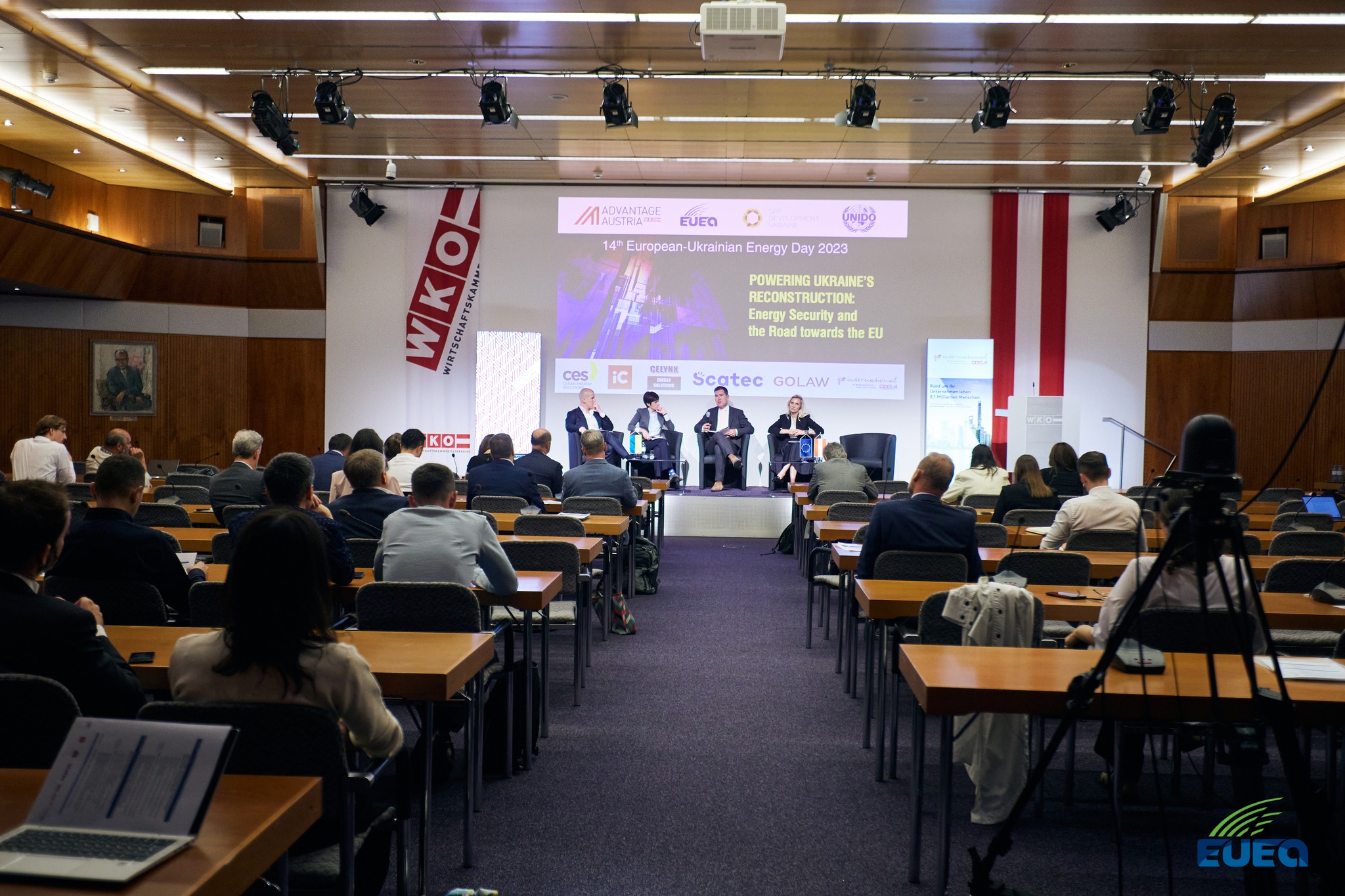
The 14th European-Ukrainian Energy Day is over. The event brought together experts who openly shared their challenges, plans and vision of where the direction into which the Ukrainian energy sector should develop. We have selected key messages from our speakers to share with you the main take aways from the Energy Day:
Natalia Mykolska, member of Ukrhydroenergo Supervisory Board.
“Over the past 3 years, Ukrhydroenergo raised more than $500 million from international financial institutions, including $211 million from the International Bank for Reconstruction and Development (IBRD) and the Clean Technology Fund for the hybrid systems project. Unfortunately, the war changed our plans. Since the start of massive shelling in Ukraine, we experienced 50 strikes on our power facilities and lost 2000 MW of generating capacities during the last autumn and winter. We managed to restore only about half of it. Our company’s total losses amounted to €1.5 billion. The largest losses incurred due to the undermining of the dam at Kakhovka HPP.
That is why the priority projects now are the projects focused on restoring lost capacities. Nevertheless, we also do not forget about development projects – the construction of 5-7 units of the Dniester PSPP, the project of the new Kaniv PSPP. We are working on a project to restore Kakhovka hydroelectric power station and green hydrogen. In addition, we are updating the project for hybrid systems. These projects will contribute to stable operation and restoration of the energy infrastructure after the losses caused by the shelling.”
Dirk Buschle, Deputy Director of the Energy Community Secretariat.
“Ukraine’s strong potential in renewable energy remains, as does the European Union’s huge interest in this sector of Ukrainian energy. The most visible effect was the price cap increase that took place in late spring this year. This is not only important for the attractiveness of the renewable energy sector, it is also important for the security of energy supply in Ukraine, given that Ukraine is also moving towards price convergence with the European market.”
Hanna Zamazeyeva, Head of the State Agency on Energy Efficiency and Energy Saving of Ukraine
“I think that right now is one of the few chances when we have everything to implement energy efficiency and decarbonisation policies as part of Ukraine’s energy and economic strategy. To do this, we need to clearly understand the criteria by which international financial institutions assess risks in our country and how they prioritise projects in Ukraine to attract financial, technical assistance or investment in our domestic projects, which are very diverse: energy efficiency measures in all sectors, renewable and alternative energy sources – biomass, biomethane, hydrogen, cogeneration, wind power development, solar power plants and much more. During my recent visit to the United States, I heard the word “corruption” more times than ever in my life. It is also not the least important criteria influencing decisions on aid and investment in Ukraine. For me, understanding the priorities and parameters of cooperation with international partners and linking them to the clear, specific needs of different segments of the population and business in Ukraine is a crucial factor in understanding how we should build cooperation with international organisations and donors to rebuild and revive Ukraine better than it was!”
Serhiy Porovskyy, Principal Expert on Energy Efficiency Financing and Policy, UNIDO
«At the times of unjust, unprovoked, bloody war that russia launched on Ukraine, Ukraine and Ukrainians are fighting back. This has unprecedent impact far outside the borders of Ukraine in terms of protection of human values, securitization of energy and food supply chains. So of course, Ukraine is entitled for international support. That is not something Ukraine has to beg for, but what is international community is obligated to provide. International organizations, including IFIs and UN agencies were specifically established to provide such support at unprecedent times of scrutiny. What is needed is to – first – articulate the needs and to – second – build relevant mechanisms for channelling the support. On first – articulation the need – it is of course the government of Ukraine task, but we – as international organizations also can help there. As in the government of Ukraine sometimes is a mixed understanding on who can provide support, which way, which sector, how and, foremost, is it not a ‘wish’ of international organizations, but our moral and functional responsibility. On the second. I observe some seriously wrong tendency of creating something to manage programmes for Ukraine outside of Ukraine. This is largely wrong. Believe me it is a very different perception of needs and its time urgency when you are in Vienna, London, Geneva, Berlin, New York, or when you are in Kyiv. Thus, if that is the capacity we need to build – including technical and managerial capacity – that it MUST be build and it MUST be built in Ukraine! We at UNIDO, looking on how to expand already successfully implemented mechanisms like the Loan Guarantee Fund. We also support creation of the already mentioned by SAEE the National Decarbonization Platform. We intend to discuss concrete multimillion cooperation we can do to enable industrial energy efficiency, decarbonization of the real sector of economy, transfer of the Best Available Technology, and to provide extensive training programme on energy management to different groups of users».
Rouven Stubbe, Senior Consultant – Energy and Climate Policy, Berlin Economics
The green recovery of Ukraine is possible and can be economically viable. Our research shows that rebuilding multi-apartment buildings to advanced green standards would pay for itself in 9 years (assuming future liberalization of Ukraine’s energy market). Ukrainian enterprises have the potential to produce up to 90 percent of the materials needed to rebuild Ukraine with appropriate investment (USAID study).”
Iryna Fedorenko, Investment Adviser, NEFCO
During the war, NEFCO initiated the Green Recovery Programme for Ukraine. The programme is a multi-donor initiative led by the EU and the Nordic countries as the main lead donors of the programme, which aims to achieve a sustainable green recovery of Ukraine. Through its various initiatives, the programme provides financial support and technical assistance to municipalities to overcome both the direct and indirect consequences of the war. The financial support is used to restore municipal infrastructure in an environmentally sustainable way, to restore and build housing for internally displaced persons (IDPs), and to build capacity to develop local green recovery plans. The programme contributes to the green recovery of the country, supporting municipalities and strengthening local governance as part of the development of Ukraine’s green economy. More than 35 projects are currently being implemented under the Green Recovery Programme for Ukraine.
Nadiya Petrushenko, SPP, Commercial Director
“Given Ukraine’s membership in the European network of electricity transmission system operators and the requirement to provide the necessary volume for primary frequency control, it becomes clear that the construction of energy storage systems is a priority for Ukraine. It is important to note that Ukraine is currently dominated by mechanical capacities, primarily TPPs and HPPs. However, high manoeuvrability is still largely absent. Limited flexibility is also another major problem for our country. This is due to both the significant contribution of nuclear generation and the steady growth of renewable energy production. The last statement is, of course, essential for the modern development of the energy system. In the light of the imbalance between generating capacity and the ability to quickly respond and regulate, the issue of ensuring the stability of the energy system is obvious.” “If we go deeper, we will see that Ukraine’s energy system demonstrates the ambitions of our country. We are moving towards reducing carbon emissions, increasing the share of renewable energy sources and developing green hydrogen technologies. Voltage fluctuations due to the growth of renewable energy sources highlight the urgent need for efficient and reliable energy storage solutions. Energy storage is a priority area for development in Ukraine’s power systems. It will facilitate frequency regulation both in standard and emergency mode. In addition, it will allow Ukraine to achieve a balance in the power system. The introduction of an energy storage system will facilitate the development of distributed generation and reduce grid losses. Ukraine has already made a significant step in the implementation of storage systems, and the legislation and regulatory framework are ready for the implementation of projects. Therefore, action is needed today.”
Silvia Martinez, Country Manager for Ukraine, World Bank
“On the World Bank side, we have been supporting, of course, during the war, mainly the state-owned enterprises Ukrhydroenergo and Ukrenergo to meet the demand. Ukrhydroenergo is preparing very important projects, and we are trying to help them and also maintain the operation of some damaged hydroelectric power plants. A slightly more difficult challenge is attracting private sector investment, or at least keeping private companies in the market. There have been many recent reforms that could help in the short term and in the future. Firstly, the Auction Law, the environmental transformation of the system law, which introduced various, very important aspects, the entry premium and the guarantees of origin, as well as a process for those companies that are under the system in the tariff regime to perhaps move to another regime that can give them more certainty about payments in the short term. We also see important steps in the corporate reform of state-owned enterprises, which may also have an impact on market performance. But, of course, these are strategic things, and it may take time for them to be implemented and have a real impact on the market.”
Igor Potapov, Managing Director, Kaiserpfalz
“The European Union’s strategy is to reach 35 billion cubic metres of biomethane on the European market. The question is whether Europe can reach this level on its own. Agricultural companies in Europe are quite small, and I am quite pessimistic that the planned biomethane targets can be achieved exclusively by European agricultural companies. To have a conventional biomethane plant, you need about 100,000 tonnes of agricultural waste. If you have 100 or 200 hectares of land on your farm, it is impossible to maintain it. In Ukraine, there are probably 150 or 200 agricultural companies that manage more than 10,000 hectares of land. This means that the country has the necessary capacity, with this size of land and the appropriate investment (from €10 million per project), and we can produce a product from agricultural waste that could be exported to Europe.”