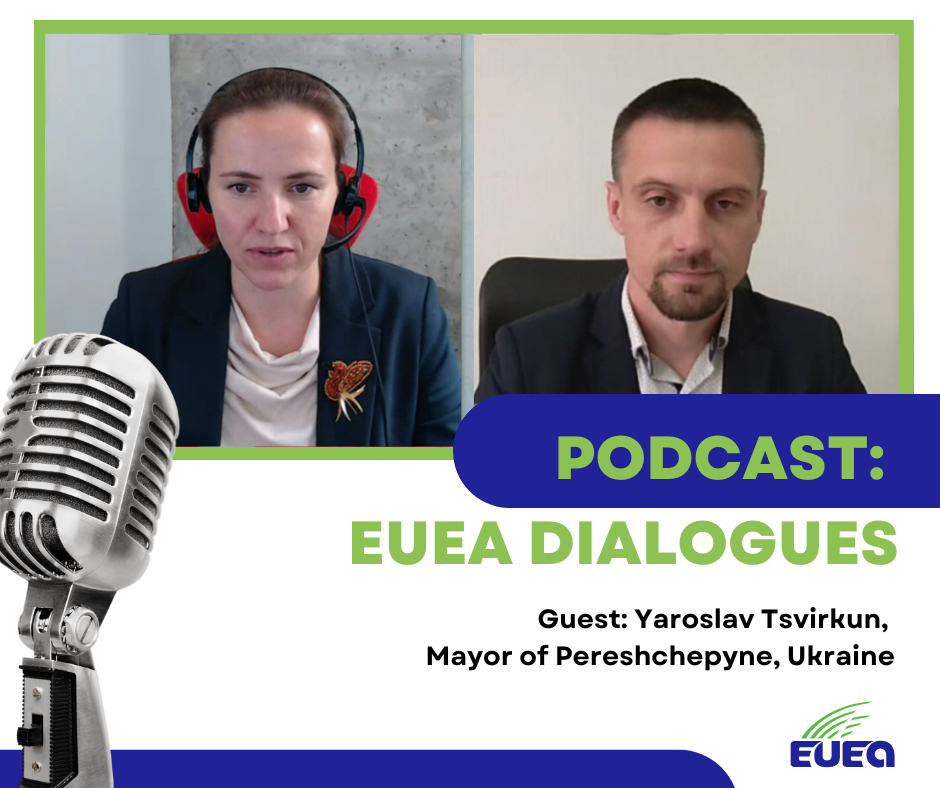
Yaroslav, your community is neither very small nor particularly large, with a population of around 20,000 people. It’s located in Dnipropetrovsk Region, only a few hundred kilometres from the frontline. How are you coping with today’s challenges? What are those challenges? And how do you plan for economic development during these times?
More specifically, our community lies on the border between Dnipropetrovsk and Kharkiv Oblasts, not far from the active combat zone. We have received a significant number of internally displaced persons (IDPs), which has created real challenges for us. We are doing everything we can to support them, so securing financial resources and encouraging investment activity are critical. We need to create new jobs and provide housing. That’s why cooperation with international partners is so important — not only to attract donors, but also to bring in new entrepreneurs and companies that can generate employment in our community.
As a mayor, you face numerous priorities, with urgent issues arising nearly every day. How do you decide what is most important, such as infrastructure, energy supply, or housing? Our community comprises 21 settlements, including one town and 20 villages, with a population of approximately 21,000 citizens, each having unique needs and priorities. To set clear priorities, we focused on preparing a local development strategy. This strategy was created collaboratively with residents, international partners, regional administration, and international experts. The key areas we identified include water supply, infrastructure, job creation, and healthcare.
Are there any international projects in your community that you’re particularly proud of?
Yes, we have several. A German donor even produced a film about our work with the community. They contributed significantly by helping to build a new hospital, with an investment of approximately €1.5 million. That was a major contribution. We are also in the process of establishing new partnerships with German municipalities and hope to sign memorandum of cooperation soon.
One of the best examples of our international collaboration is with Slovenia, specifically with the Municipality of Idrija. We are currently working together on waste management initiatives, as we aim to improve our environment.
What is your overall impression? Are there enough financial tools and programs available for communities like yours? What could be improved?
I believe that larger cities and municipalities have certain advantages. They typically have larger budgets and more resources to hire highly skilled staff, often fluent in English, who can attract funding and develop projects.
In contrast, it’s more challenging for us. Small towns have fewer individuals who can help us build new partnerships and secure resources.
You are one of those young, dynamic, English-speaking mayors in Ukraine, which is quite rare. Your community is fortunate to have you. How many people are on your team for the international initiatives you mentioned?
Our team consists of a total of 70 people, but the Department for International Cooperation and Investment Resources has only three specialists. While our team may be small compared to those in Kyiv or Lviv, we are always looking for ways to build our capacity. We focus on providing English training, project management courses, and more.
Is there a project in your community that you’re particularly excited about, one that has great potential but lacks funding or partners? Smaller communities often struggle to access multimillion-euro investments, and obtaining loans can be challenging.
Yes, we have several ideas and projects we would like to implement. For example, we are facing a significant housing shortage due to the large number of internally displaced persons (IDPs) seeking temporary or permanent accommodation. Both IDPs and locals are affected by this situation, creating a promising market for construction companies to build new housing units for sale.
Another project involves establishing a new waste management centre, as I mentioned earlier. We are exploring potential resources, possibly even from private companies, as this is a growing market. Aiming to meet EU standards, there is significant potential for public-private cooperation in this area.
Every project requires people, funding, technical assistance, and qualified contractors. Which type of support from international partners would be the most valuable? Is it simply financial assistance, or is there more to consider?
In reality, everything begins with personal contacts. At conferences and during conversations with mayors from other countries, the most common advice is to start small. This could involve an exchange program or a donation of equipment to support us during wartime. From there, we can develop joint projects step by step.
I’ve spoken with businesspeople from Germany, Slovenia, and other countries — all of them are interested in collaborating with Ukraine. However, we first need to prepare investment passports and highlight our community’s strengths. That’s why we are working with Dutch experts to create new investment passports that showcase what we have to offer.
How often do you hear phrases like, “You’re just 200 kilometres from the frontline — we won’t go there”?
Currently, we don’t hear such concerns. People are still conducting business in Odesa, shops are open, and infrastructure is developing. While it may not be the ideal time to launch a large business, smaller projects are certainly feasible.
Additionally, there are Ukrainian investors interested in collaborating with communities like ours. In fact, it can sometimes be easier to find Ukrainian partners, which is something we are actively exploring.
In your opinion, how should the Ukrainian government change its approach to funding for small communities?
There is currently an important conversation, both in Ukraine and among international partners, about creating a national budget process that includes public participation, especially from small communities.
This is why I intend to work closely with regional and national authorities. They need to consult small municipalities to understand their real needs and priorities. We are trying to participate in national programs, but it’s challenging.
The state tends to prioritise support for large cities first, then for mid-sized cities, leaving small communities to receive assistance last, potentially in ten years.
However, our most urgent needs, such as water supply and services for the villages that have taken in the most displaced people, cannot wait. It will be difficult to wait so long.
During over three years of full-scale war, how often have government or international organizations asked you directly about the needs of your community?
We have collaborated extensively with the Dnipropetrovsk Regional Administration. International organisations frequently approach them to identify the real needs across the region. I know we gained foreign partners thanks to the regional department of international relations. Before a conference abroad, they connected us with foreign mayors. They also signed memoranda of cooperation between Ukrainian and German regions, which led to local-level partnerships like ours.
What investment tools would be most effective for your community? I recall a mayor once saying at a donor conference, “Don’t give me money. Give me equipment, give me people, and come work with us.” Money often comes with bureaucracy and oversight. What would work best for you?
First, we need to be honest with our partners. We should communicate our needs and take meaningful action. When we collaborated on a waste management project with our Slovenian partners, we divided it into three phases over three years. At one point, we lost contact because it was year-end, and they were planning their budgets. When they returned and indicated they were ready to proceed, we had already completed phase one using our local funds. That impressed them.
Second, we don’t always need direct funding. I suggested to our Slovenian partners that they bring a company from Slovenia or Ukraine to help us. Let them work and develop business, and we will receive a new waste centre along with new jobs. For us, it’s more about the resources for implementation rather than just money.
However, that won’t be effective for street lighting, schools, or kindergartens. For those projects, you would need grants or loans programs, correct? What financial tools would be most suitable for your community, perhaps small loan programs?
In this situation, international cooperation is essential, involving experts from various fields and partnerships with international organisations.
Does your municipality currently have any loans — from NEFCO, EIB, EBRD, or similar?
No, we don’t.
Have you tried applying for one?
No, we haven’t.
Why not?
I believe that such cooperation is mainly a good opportunity for larger cities.
This may be the crux of the problem: why does a large city have the ability to apply for and receive a loan, while a community like yours does not even attempt to do so? Is it because the process is inaccessible or overly complicated? Or perhaps it’s due to a lack of awareness or research into this topic?
We haven’t attempted to apply for loans primarily due to our lack of experience. Additionally, we need skilled lawyers and individuals who are fluent in English and possess international experience. This shortage of expertise contributes to our inexperience, which is why we haven’t even tried. However, I am confident that we will make an effort shortly. This will be a new experience for us, and I hope it leads to a success story.
Have you heard of any loan programs that might be interesting and accessible for communities like yours? I often hear that many institutions do not finance projects or investments smaller than, say, 10 million euros. For a community like yours, securing a loan of this size from an international organisation is quite challenging, isn’t it? Additionally, the number of loans for smaller amounts is limited. Do you have any information about financial products available to your community? Or is there still an opportunity for creating such products?
Loans for projects in areas like water supply or energy efficiency could be highly beneficial for us, as they would help save money in the near future. However, we need support from the government or perhaps the regional administration to make it feasible, as it would take a very long time for the community to repay the loans independently.
For us Ukrainians, long-term planning has never been easy, even before the war. Now, we can only plan one or two years ahead. However, energy efficiency projects require 15 to 20 years to pay off. This is something that donors need to consider when designing financial tools for small communities. I see a problem in the market—a vicious cycle. Without modernised schools, kindergartens, hospitals, and other public buildings, it’s impossible to keep people in the area. If we can’t retain residents, there will be no skilled workers available to implement energy efficiency projects. We need to break this cycle, perhaps with the help of more accessible loan programs.
To conclude our conversation, I have a request. Please imagine you are standing in front of several international donors, financial organisations, or investors. How would you present small communities, such as Pereshchepyn, to them to receive the attention and support needed for the reconstruction of Ukraine?
The strength of small communities lies in our motivation. Big cities attract numerous donors and partners, but they also come with significant bureaucracy. A small, motivated community can quickly organise and implement projects, and we are open to cooperation.
Podcast is available for viewing at the following link