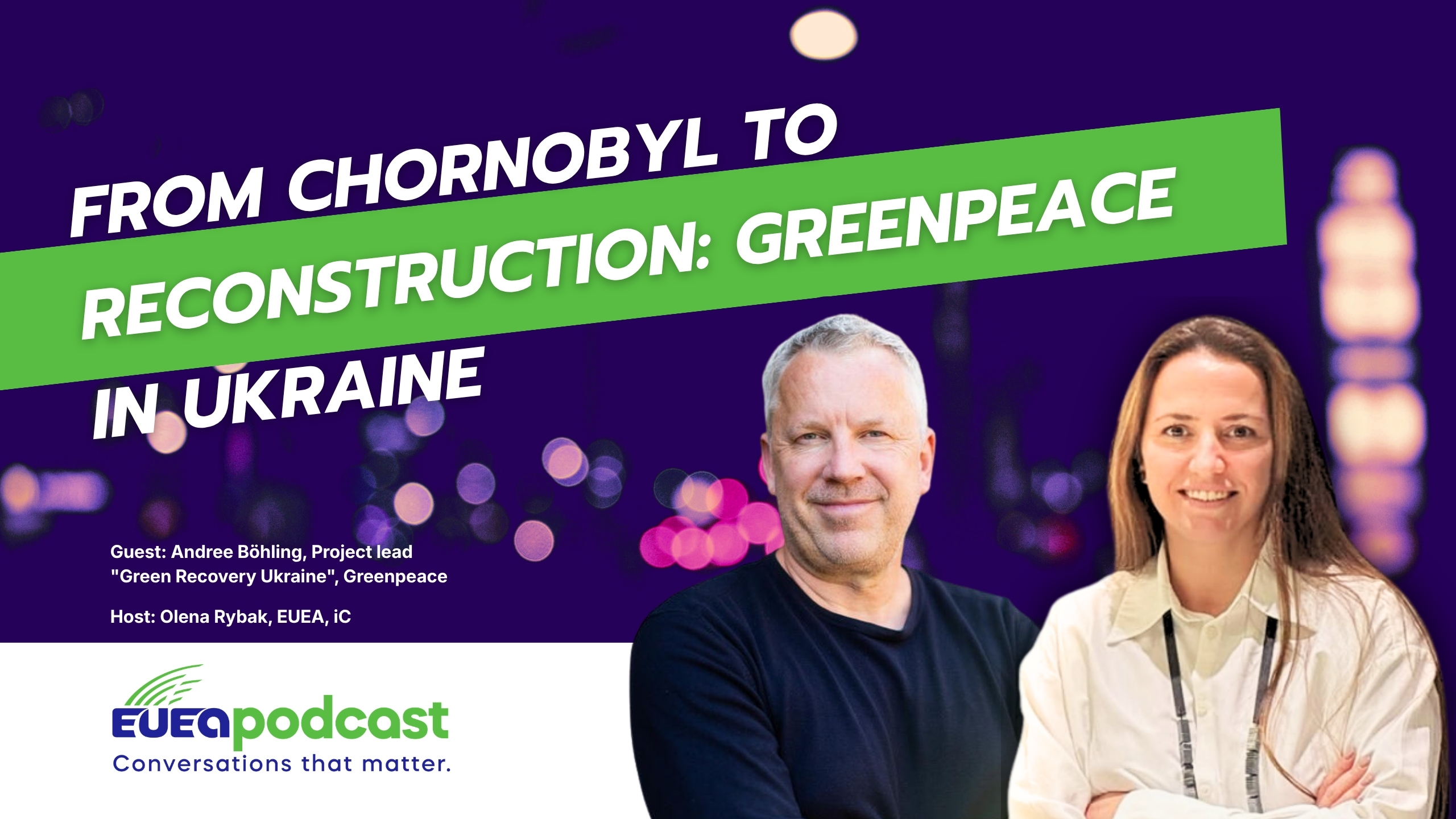
Podcast with Andree Böhling, Project lead “Green Recovery Ukraine” and Energy expert at Greenpeace
Podcast Host – Olena Rybak, Vice-Chair of the Board of the European-Ukrainian Energy Agency, Managing Director of iC consulenten in Ukraine.
How would you describe what Greenpeace is actually doing beyond the public image of activism and environmental campaigns?
— Greenpeace is widely known for its actions — iconic and courageous actions of activists who aim to stop environmental crime.
At the same time, over the last decades Greenpeace campaigns have developed further. The organization has built significant expertise and today supports political conversations and decision-making processes.
Greenpeace also works as a mentor for volunteers, communities and other actors within the environmental movement who share similar values.
As part of civil society, the organization participates in protests and organizes them together with partners. Over the years Greenpeace has also become more international through stronger collaboration between countries.
What are Greenpeace’s main geographical focus areas today? Are the priorities mainly within the European Union or more global?
— Greenpeace’s global strategy largely follows the major global conflicts and threats, including climate change, wars, and the destruction of seas, oceans and forests.
The organization also focuses on the countries that are considered most relevant in influencing these developments and where positive impact can be achieved.
Europe is definitely one of the important focus areas, but Greenpeace is also active across other continents and countries, including China, Brazil and the United States, where major political and environmental discussions are taking place.
And what about Ukraine? How did we become one of your focus areas?
— Ukraine is seen as a very important part of Europe and relevant for Europe’s future overall.
For Greenpeace, Ukraine is also closely connected to the organization’s history because of the Chornobyl nuclear disaster in 1986.
For decades Greenpeace has worked on issues related to nuclear safety, and Chornobyl became one of the clearest examples of the risks and negative impacts connected to this technology.
After the full-scale Russian invasion in 2022, one of Greenpeace’s first missions focused on monitoring the impacts of the Russian occupation of the Chornobyl nuclear power plant and the surrounding region, as well as the nuclear risks connected to it.
This became the starting point of Greenpeace’s recent work related to Ukraine.
What else are you doing currently? Are you involved in reconstruction, and what are your core activities today?
— The first activities started after the nuclear disaster at the end of the 80s and the beginning of the 90s. Greenpeace even opened a small office in Ukraine at that time, but after some years it was not able to continue and was closed again.
Still, work in Ukraine continued for decades on energy policy and nuclear safety.
With the Russian aggression in 2014, and especially after the full-scale invasion in 2022, Ukraine again became a stronger focus for the organization, as well as for the broader public in Europe.
At that point, work started again on monitoring nuclear safety for people living around Chernobyl and around Zaporizhzhia. The organization also began to discuss what else could be done in the country.
From there, ideas around greener solutions for reconstruction emerged, as well as the use of renewable energy in this context. In 2023 a project was created for three years to work on green reconstruction concepts, to support nuclear safety for people and the country in general.
But if we look at the last four years or three between 2020 to 2023, you started and reopened the office. Are there any two or three initiatives or projects, highlights that you are specifically proud of?
— It’s always hard to select, not to offend anyone, as they are all important in different ways.
But there are some where I was more involved, and some where there was more political impact already.
The political impact can be seen in projects and investigations around the Russian shadow fleet, which actually led to political action at EU level, including sanctions and investigations against these shadow fleet operations.
Another important area is the work around the Zaporizhzhia nuclear power plant, which is still effectively in Russian control. There were attempts to restart it, which could have created huge risks for people living nearby. Colleagues investigated and monitored the situation and found evidence of Russian restart initiatives, which led to public interventions, including from the International Atomic Energy Agency. There is pride in this influence and in supporting the country in that context.
On a more personal level, involvement was stronger in solution-oriented projects. One of them focuses on supporting hospitals during the energy crisis. Critical infrastructure and medical services need reliable energy supply, so a project was initiated around solar energy, with donations from Germany and other European countries. It started with older recycled solar panels brought to hospitals in Ukraine and later expanded through a competition where more than 100 cluster hospitals applied for support.
So far, panels and battery systems have already been delivered to around 20 hospitals in Ukraine, helping to secure energy supply in very difficult winter conditions. These are battery-connected solar systems that directly support hospitals in a critical situation.
Another project is connected to the city of Trostianets, focusing on the heating sector, which is often not in the focus of international aid. It deals with private multi-family buildings, an area that is also not highly supported internationally, but where there is strong local need and engagement.
Can you tell us a bit more about what this solution implied and what exactly was done?
— This initiative started with a conversation, and IC Ukraine was also involved. The city developed a master plan to phase out fossil gas in their city, as part of reconstruction after the Russian occupation.
There was a meeting with the mayor during an information tour in Vienna, where there was a clear alignment in values: energy transition, climate protection, energy independence from Russia and from fossil fuels in general.
Based on this, a project was developed to support the city on this path, which is a longer transition towards becoming fossil-free. The starting point was a multifamily building of around 60 apartments, which had been damaged during Russian aggression and then rebuilt.
After reconstruction and efficiency measures, it was planned to reconnect it to fossil gas, which was seen by us as the wrong direction and a false signal. Instead, a pilot and demonstration project for Ukraine was initiated.
The goal was to show both decision-makers and the public that even in large buildings, and even in a city like Trostianets close to the Russian border and with regular attacks, it is possible to use renewable energy solutions such as heat pumps, solar and geothermal energy to supply housing.
It was designed as a project that gives hope and demonstrates what is technically possible, and it is considered a very strong message and an important pilot project.
Since Greenpeace is an NGO, could you explain how your activities are normally funded — is it mainly through private donors, foundations, or any form of state or project-based financing, including your work in Ukraine?
— In the Greenpeace world it is a bit different, but the main principle is independence from public money from governments or ministries.
The organization also does not take money from business to run its projects. Funding is based on private donations, including in Germany from more than 600,000 people who contribute small or larger amounts.
Internationally, there is also support from foundations. For example, the European Climate Foundation in Europe supports some climate protection and energy transition projects. There is also the Greenpeace Environmental Foundation in Germany, which supports projects in Ukraine.
In addition, funding comes from Greenpeace offices such as Greenpeace Germany and Greenpeace Central and Eastern Europe, including resources and personnel.
For some projects, external funding is also used, such as in the Solar for Ukraine project, which provides solar panels and batteries for municipalities and hospitals. In this case, Greenpeace acts more as a connector between funding and the final beneficiaries, rather than receiving and managing the funds directly.
How many people currently work in the Ukrainian office?
— The office was opened about one and a half years ago, at a time when many organizations were leaving Kyiv. It was seen as a strong message of support to those who stayed.
Today, there are around 10 people working in the Kyiv office, mainly Ukrainians — mostly young, female and highly motivated, with a strong ability to learn quickly.
In addition, there are about five more colleagues who support the Ukrainian team from outside. Some of them regularly visit Kyiv and the country and stay for several weeks several times a year.
And as you frequently travel to Ukraine during the past four years, in what has been a very difficult environment, is there anything that is particularly challenging for you as an NGO working in Ukraine?
— There are many difficulties. The war environment is also very hard on a personal level, because it requires a strict security protocol.
For example, if there are increased air alerts, it is necessary to go to shelters. There were periods when there were alerts almost every second night. This is very challenging and a taste of what the people in Ukraine are going through.
And beyond the security aspect, are there other challenges in your work in Ukraine, for example related to travel, administration or the broader environment?
— There are also travel restrictions. Within three years, it was possible to go to the city of Trostianets only once because of the strict protocol for travelling to risky regions such as Sumy.
There are also legal and administrative challenges between German bureaucracy and Ukrainian bureaucracy. The language can be challenging at times as well.
In addition, there is missing expertise at community and sometimes municipal level, where the necessary experience is not always available.
But the main challenge is also the perception from outside of Ukraine about the situation and about the opportunities. There is still a lack of information about the huge potential for investment in renewables.
There is often a misunderstanding that the war means everything is attacked everywhere, including solar panels, for example. In reality, renewables are currently one of the key solutions to invest in and are relatively harder to damage compared to other energy technologies.
For this reason, a lot of work is being done to improve this perception and to support international and Ukrainian investors in the sector. The opportunities are there, and there is also strong support from governments and international financial institutions in terms of risk insurance and project development.
If we look at the upcoming two, three or even four years, is there anything you would highlight in terms of Greenpeace strategy for Ukraine in the future?
— The first learning is that it is not really possible to plan in a traditional way, because the situation is very hard to anticipate. Flexibility is needed. This is also a learning for the organization, which normally relies on structured strategic planning and control.
In this context, a different approach and mindset is required.
Another important direction is working more closely with communities, including women, youth and local people. This is seen as the best investment.
There is also a strong focus on municipalities and local level cooperation, because they are often able to act faster than national level institutions. They have motivation, energy and engagement.
Many of them are actively developing plans, working with European partners and taking more ownership of their development processes.
But we are talking about the energy and climate sector, renewables and reconstruction activities. Do you have any priority topics more generally?
— For us, the energy sector is a main focus of the work. But there are also connected issues, such as biodiversity, which is another important area because of the global biodiversity crisis.
In addition, there is the expectation that after a potential peace agreement, there will be significant investment flows into Ukraine, both public and private. These investments could be positive or negative from an environmental perspective.
In this context, there is also a role as a watchdog, monitoring what these investments mean for nature, biodiversity and the country’s resources in the future.
Another important aspect is work within the civil sector, including democracy and anti-authoritarian values, which are seen as shared and important to protect.
Finally, there is a clear intention to become more visible and to strengthen collaboration with partner offices in Europe, because cooperation between Ukraine and European actors is considered essential.
And when looking at biodiversity and environmental damage caused by Russian aggression, how is Greenpeace working with these issues in Ukraine and what are the main focus areas in this context?
— Yes, of course, this is also relevant for Greenpeace. One of the biggest examples of impact is the marine environment, including work together with the organization Truth Hounds on assessing environmental damages in affected regions after Russian destruction oft he Kakhovka damn. Then there were huge impacts on the marine environment with Russian Shadow Fleet oil spills, including monitoring of impacts on animals in the seas and the wider ecosystem.
There have also been local activities focused on the protection of mountain regions and discussions around renewables in the Carpathians. This topic is also partly controversial within the team, as there is agreement that there is enough available surface and that large-scale wind energy development in mountain areas should not proceed without full legal procedures and permits.
At the same time, it is important not to create a perception that wind energy is negative, as Greenpeace continues to support wind power and renewables in general. The approach includes sharing experience and guidance from other countries on how to plan development in sensitive areas and what needs to be protected in detail.
In general, renewable energy projects in sensitive biodiversity areas must be carefully planned and properly managed, because if unplanned or poorly implemented they can create more damage than value. These technologies have a right to exist, but require responsibility, planning and care.
Over the last decade, discussions around nuclear energy in Ukraine have repeatedly returned, and now the topic seems to be gaining momentum again, with preparation activities already ongoing for potential new nuclear power plant construction. Where does Greenpeace stand on this process and what is your position on further nuclear development in Ukraine?
— Greenpeace’s position has been very clear for decades. The organization supports renewable energy development and opposes new investments in nuclear power, as these projects are extremely expensive and connected to major long-term problems, including security risks, as demonstrated by Chornobyl, as well as unresolved questions around nuclear waste disposal.
At the same time, the Ukrainian case is viewed in a specific context, since the existing nuclear power plants remain very important for the country’s current energy supply.
Greenpeace is therefore not acting against the current reactors, but clearly opposes new nuclear investments.
The focus is primarily on nuclear safety, especially considering the situation around Chornobyl after the Russian attack on the confinement structure, as well as Zaporizhzhia and Russian control of the plant. Russian attacks on energy infrastructure connected to nuclear facilities are also part of the broader nuclear risk.
In the coming months and years, Greenpeace also plans to develop energy concepts showing that alternatives exist and that Ukraine can move faster, cheaper and with greater benefits for independence and security through renewable energy solutions.
When looking at the pictures of the damage to the Chornobyl confinement structure, it may not appear very significant compared to the overall size of the installation. However, based on your investigations and expertise, is the damage really serious enough that the structure would need to be fully dismantled and rebuilt?
— This conclusion comes not only from Greenpeace experts with decades of experience in nuclear safety, but also from scientists involved in constructing the confinement structure itself. One of them investigated the site and contributed to the report that was recently released.
The conclusion is also shared by the Ukrainian government: the confinement structure is in a very critical condition. It requires enormous investment, and it is still unclear whether the situation can be fully stabilized.
The damage was not limited to a small external hole — there were also major internal damages. There is still uncertainty around the structural stability of the confinement and whether a larger collapse could potentially happen.
These conclusions are based on scientific evidence and are being taken very seriously. A broader political discussion has already started around the scale of funding needed to stabilize the situation, especially considering that the confinement itself was already an enormous investment.
The confinement itself was also an enormous international investment. What scale of funding are we actually talking about for the construction and now for the stabilization efforts?
— The original confinement project required an enormous international funding package and several years of construction. The total investments were already over two billion Euro.
Recently, the United States alone announced around 100 million in support, while other countries are also discussing additional contributions. Significant international funding will again be needed to stabilize the situation and address the damage.
In your work with Ukrainian communities, how are reconstruction efforts and renewable energy currently being perceived? Do you still encounter skepticism around renewables, or has the attitude changed over recent years?
— Skepticism has not completely disappeared and still exists to some extent. At the same time, there have been quite fast changes in perception.
One of the main drivers is the war and the collapse of the old centralized system. On local level, mayors and municipalities can no longer fully rely on centralized energy supply.
At the same time, many local authorities see opportunities to act independently, search for international support and develop local solutions, especially because national support is often limited.
There is also a growing effect of municipalities learning from each other and following pioneers who implement renewable and reconstruction projects with international funding.
Overall, the crisis has become a driver of transformation and created strong motivation among communities to implement change.
But of course, the situation is not the same in every municipality. Do you see any risks of things going dramatically wrong in the reconstruction sector?
— One of the biggest risks is that very large investment flows could enter Ukraine quickly and be driven by interests that are not aligned with long-term sustainable development.
This could include investments connected to fossil fuels, gas, nuclear energy and other older technologies.
While investments are urgently needed, there is a risk of lock-ins and pathways that could contradict Ukraine’s long-term goals, especially in the context of EU integration.
The EU is moving towards the Green Deal, greater independence from fossil fuels and stronger renewable energy development.
From this perspective, reconstruction investments could shift towards outdated technologies instead of future-oriented solutions.
What is your personal motivation for working in Ukraine right now, and what originally brought you to Greenpeace?
— The motivation has changed over the years. The decision to join Greenpeace came from an academic background and understanding of climate change and global injustice.
Later, involvement in the anti-nuclear movement in Germany showed what activism means in practice.
There have now been around 20 years at Greenpeace. In recent years, motivation has increasingly come from sharing experience from countries with more advanced energy transitions, especially Germany, where renewables grew from around 6% in 2000 to around 60% today.
There was also previous familiarity with Ukraine and Kyiv, and after the full-scale invasion there was a stronger personal connection through colleagues working on nuclear issues, including after Fukushima.
The Russian invasion became a strong motivation to support Ukraine, especially because its future is closely connected to Europe’s future.
If you had to identify three main priorities for Ukraine over the coming years with international support, what would they be?
— First, preparation for the next winter and support for energy supply, especially for municipalities and households.
Second, stronger sanctions, particularly against Russian oil, gas and nuclear sectors.
Third, stronger international cooperation to stop the aggression and achieve peace and victory for Ukraine.
If there is one key message you would like the audience to take away from today’s conversation, what would it be?
— It is important to understand that even after four years of war, there are still many people who support Ukraine, follow what is happening, stand in solidarity and donate. Ukraine is not alone.