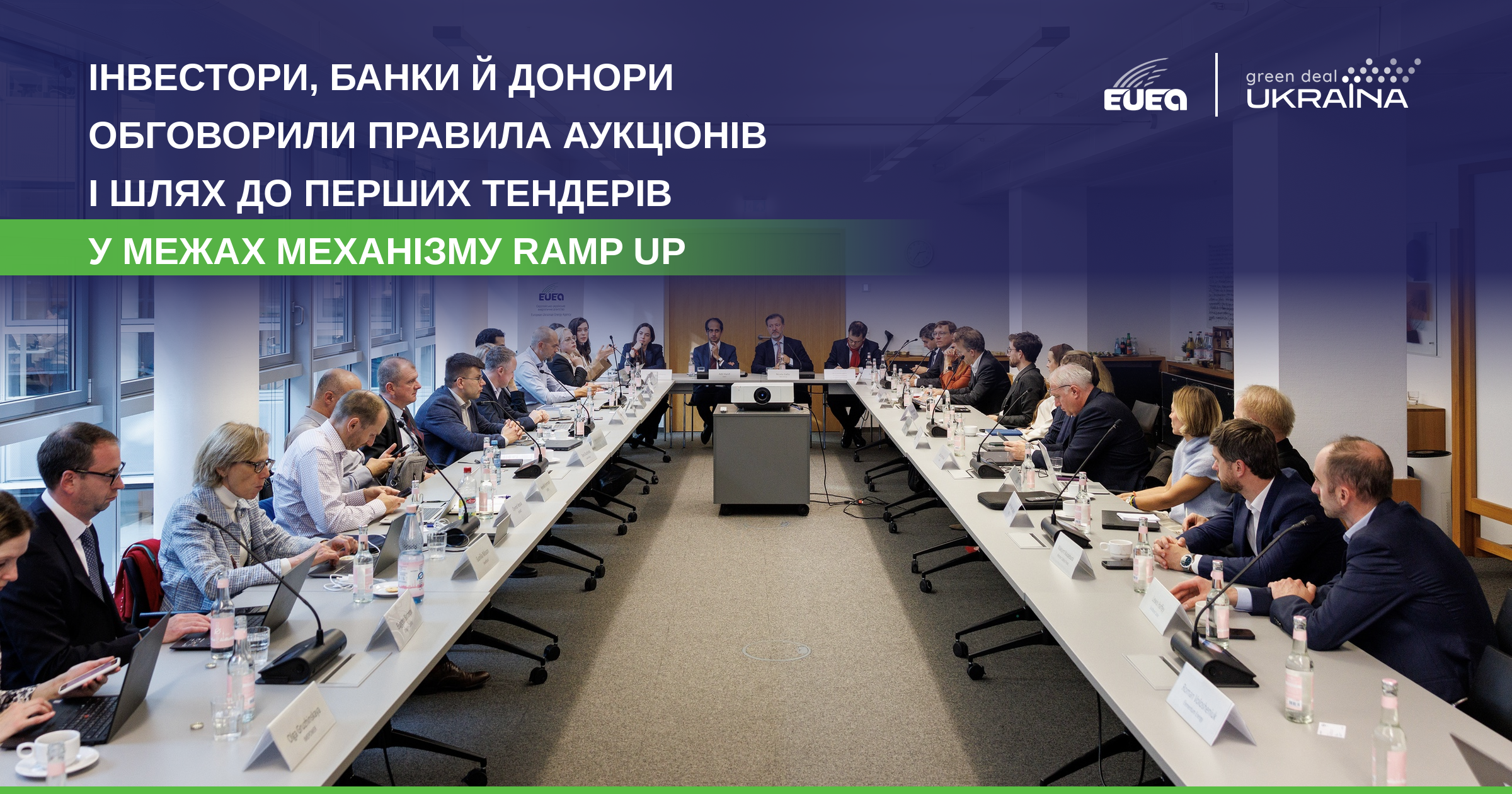
Most questions were about how the tender rules would work in practice. Investment funds wanted to know which qualification requirements would apply to them and when a project could leave the mechanism or change hands. Project developers asked how wind farms with battery storage on the same site would be treated and when solar plus storage projects could count on support. Participants asked for early clarity on environmental, social and cybersecurity requirements and on what is expected from equipment suppliers, and they also brought up the practical difficulties of bid guarantees and currency rules.
Some of the market’s requests have already made it into the design after earlier consultations with investors, with the team moving to a monthly reference price and changing how additional revenue is split so that producers keep a larger share. The suggestions made in Berlin will be taken into the next stage of work.
What is RAMP UP
RAMP UP is a price stabilization mechanism for new wind and solar projects with energy storage in Ukraine, designed to give investors and banks the long-term revenue certainty the market lacks today. With the war on, it is hard to find a reliable buyer for power under a long-term contract, and banks don’t see sales on the day-ahead market as a strong enough guarantee to finance projects.
How it works
Auctions. Projects will compete for support in auctions where price is the main criterion.
Scale. The first auction covers 400–500 MW, and the program as a whole aims for about 1 GW of new wind and solar capacity with storage.
Price stabilization. If the market price drops below the contract price, the mechanism pays the difference, and if prices rise sharply, part of the extra revenue goes back into the mechanism while producers keep most of it.
Flexible sales. Producers can sell their power in any market segment and under any type of contract.
Funding. International donors led by the European Commission provide the mechanism’s capital, while the EBRD and the World Bank Group lead its design and rollout.
Next steps
The partners are working to launch the first tender, for onshore wind, before the end of 2026, with the second expected a few months later. Solar plus storage may make it into the first round, and if not, it will be part of the second. Before the launch, the partners are considering a preliminary registration stage so the market gets an early signal and has time to prepare projects, and they plan to consult on the key terms of the price stabilization contracts later on. Meanwhile, changes to Ukrainian law that will make these contracts possible are being prepared, and the counterparty that will run the auctions is being set up.
From idea to launch
EUEA Director Anastasiia Vereshchynska recalled that two years ago the idea was only being discussed within the private sector. “I am very proud of how this mechanism is maturing. It is close to final launch and should become the biggest boost for renewable energy in Ukraine,” she said. In her view, the second meeting showed there is still room to make the mechanism convenient and effective for those who will use it. All feedback will go to the RAMP UP team, and EUEA will keep its members updated.
“Ramp-up is an ambitious approach to unlock private investment in renewables in Ukraine. The de-risking instrument will give investors access to capital at interest rates that allow a substantial expansion of much-needed electricity generation. This makes it possible to deliver cheaper electricity to off-takers,” said Georg Zachmann, Scientific Lead, Green Deal Ukraїna.