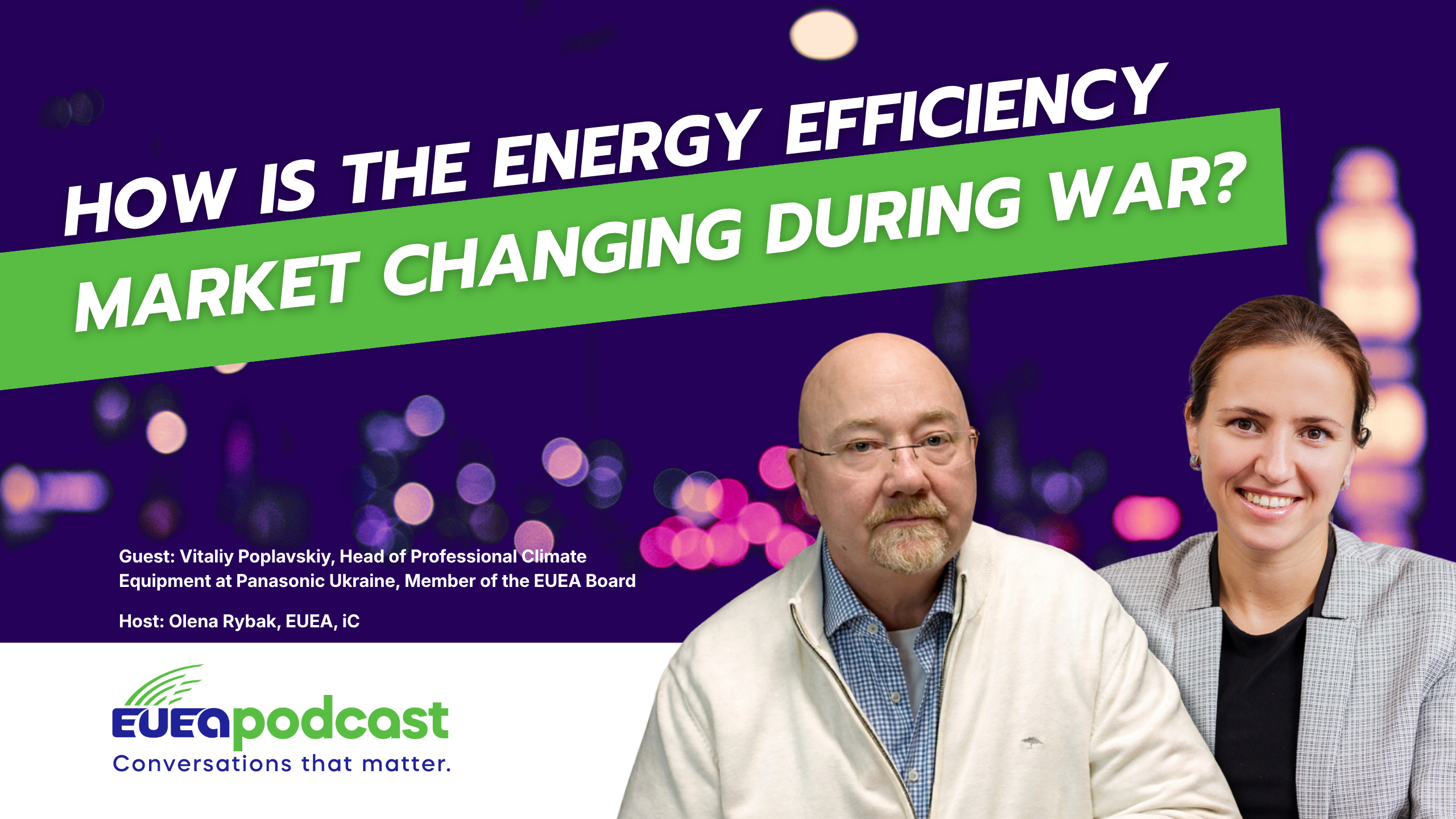
Podcast with Vitaliy Poplavskiy, Head of Professional Climate Equipment at Panasonic Ukraine, member of the EUEA Board.
Podcast Host – Olena Rybak, Vice-Chair of the Board of the European-Ukrainian Energy Agency, Managing Director of iC consulenten in Ukraine.
Usually, Panasonic is associated by a wide audience with household appliances. Has anything changed in the company’s areas of activity in recent years?
— Consumer electronics remains important; however, recently we have been placing quite a serious focus on the B2B direction, particularly on professional and specialized solutions in the climate sector. Personally, in Ukraine, I am engaged in the implementation of such energy efficiency projects in the climate segment.
Does Japan as a state provide support to Ukraine? Does your company feel this support?
— Japan is one of the leaders in supporting Ukraine. The total amount of assistance exceeds 15 billion dollars. This support is thoughtful and well-structured: it includes the transfer of technologies and professional equipment. At the same time, considerable attention is paid to ensuring that Japanese taxpayers’ money is used effectively.
The assistance covers various areas — from climate solutions, such as heat pumps in kindergartens, to humanitarian projects, such as demining.
How is the process of implementing heat pumps in kindergartens (public-sector buildings) currently taking place? Is this a frequent request from communities?
— The state’s strategy in this area has already been defined. Cooperation is being carried out with JICA (Japanese International Cooperation Agency), which, together with the key ministries (the Ministry for Communities and Territories Development and the Ministry of Education), selects the projects.
For example, within the framework of the “Winterization” program, following a tender in Japan, the equipment was selected, and at present, five facilities with heat pumps in public-sector buildings have been installed in Ukraine.
Am I right in understanding that this is grant support?
— This is an exclusively grant-based initiative — 100% support from the Japanese government, aimed at improving the energy efficiency and energy supply of social infrastructure facilities.
You have implemented five such projects in communities. What results have you achieved?
— The majority of communities (85–90%) are very satisfied. Of course, there are some shortcomings, but overall, the feedback is positive. Particularly vivid examples of energy efficiency can be seen in the kindergartens in Zhmerynka and Slavutych.
Can an average kindergarten be fully switched to this type of heating, or are backup systems needed?
— A backup system is needed. If a kindergarten operates entirely on heat pumps, it is necessary to ensure a reliable power supply. This may include an additional generator or a bivalent system — that is, a backup alternative to central heating and hot water supply. This is important for the safety of children.
Five kindergartens have already been implemented under the JICA program. Can communities still join this program?
— Yes, the program is ongoing. There are second and third phases. The first phase has already been implemented, including by our competitors, who carried out the projects professionally and with high quality. A third phase is now being prepared — tender procedures will once again take place in Japan. Ukrainian and Japanese tender procedures differ somewhat in their mechanisms, but fundamentally they operate according to the same rules.
If we are talking not about grant projects, but about a standard market-based model, what is the average payback period for heat pumps?
— If a community or a business invests in a heat pump independently, the average payback period usually ranges from 3 to 5 years, and in some cases — up to 7 years. So even without grant support, this is already quite an attractive economic proposition.
So even under current conditions, it already works. Would the payback be faster if Ukraine had market-based tariffs?”
— Exactly. And here we come to a very complex but crucial topic — tariffs. It’s an unpopular decision, but it can no longer be postponed.
Tariff increases need to be implemented quickly: currently, the country spends roughly 150 billion UAH per year on electricity subsidized by «Energoatom» and «Ukrhydro», while only about 30–35 billion UAH is needed to support socially vulnerable groups. The remaining funds could be directed toward investments in energy-efficient technologies, smart grids, and heat pumps. This is the path Europe is taking, and it’s the one we must follow as well, because technology is our future.
Speaking more broadly about the market for energy efficiency technologies — heat pumps, thermal modernization, and solutions for building reconstruction — am I right in understanding that without market-based tariffs, this market will not be able to scale?
— Partly yes, but it is important to understand that energy efficiency is always a комплекс of solutions. Everything begins with the right project logic: what exactly we are modernizing, where the losses occur, and through what means we will achieve savings.
A heat pump is only one of the tools for improving energy efficiency, but it is a very powerful and promising one. Today, it is already a popular solution in new developments, technical projects, and the modernization of various types of buildings.
However, if we are talking about scale, as in Europe, then without economically clear conditions, the market truly will not take off.
And how large is this market in Europe?
— In Europe, approximately 20 million such systems have been installed, with around 3 million sold each year. This amounts to a market worth billions of euros: production, support, job creation, installation, maintenance, calculations, and support for the construction sector — a large market segment that will also benefit our economy.
A year ago, we analyzed the supply segment for one of our projects: the waiting time for heat pumps in EU countries was about a year and a half.
How is the availability of equipment in Ukraine at the moment? Can it be obtained quickly for a project, or is there a wait of more than six months?
— Indeed, there was a period when the market faced a shortage. This was related to Russia’s full-scale war against Ukraine: demand for alternative and energy-efficient solutions in Europe surged sharply, and manufacturers simply could not keep up.
Today, this situation has largely stabilized. Demand in Europe remains high, but manufacturers have adapted, increased their volumes, and now supply is significantly more stable.
I would like to note that Panasonic has an official representative office in Ukraine. Panasonic Ukraine LLC operates here with its own warehouses and a direct brand presence in the market. Many other Japanese brands operate in Ukraine through distributors or local partners but do not have their own representative office. And a manufacturer’s direct presence in the market is truly important.
Where is this equipment currently being supplied from? Is it still Japan, or is it mostly European production now?
— Panasonic has over 40 factories worldwide. Specifically regarding heat pumps, they were previously manufactured, among other locations, in Malaysia, but now the company has launched a very powerful production facility in the Czech Republic.
Of course, we would very much like to see such production in Ukraine someday. But as of now, supplies for our market come from the Czech Republic.
And this is entirely logical, as Europe today provides significant support to energy-efficient equipment manufacturers operating within the EU.
Speaking about the demand for energy-efficient equipment today, particularly heat pumps, where do you see greater potential: in the municipal or private sector?
— The potential is significant in both sectors. For example, in Poland, heat pump sales reach hundreds of thousands of units per year, with Panasonic holding around 24–25% of the market. We are following some of the trends of the Polish market. If the tariff issue is resolved, the market will take off, because the technology is advanced and used across Europe and the world.
As for the municipal sector and larger non-residential facilities, the potential there is also very high. Simply, these projects require different, more powerful technical solutions. But the basic principle of operation remains the same.
Is there an understanding of how much tariffs need to increase for this sector to really start developing faster? How far behind are we today compared to a market-based model?
— Ukraine treats electricity as a social product. The current tariff for households is 4.23 UAH, while the actual cost is between 5 and 13–14 UAH. The difference is effectively compensated by large state-owned enterprises. For the market to move more actively, tariff increases need to be implemented gradually — in two or three stages.
And another important point: support must be targeted. The state should truly help those who need it most. But when the same tariff is paid by both a high-income individual and a pensioner who can barely cover basic expenses, this raises questions about the model itself.
Raising tariffs is an unpopular decision, but there is no other way. No country has built a modern energy market without market-based tariffs. And in any case, we are paying for it one way or another — either directly, or through the cost of goods, services, heat, and water.
In the projects you implement, whether in communities or the private sector, what is the most challenging aspect for you, and where is the biggest gap in the Ukrainian context?
— There are several key challenges. First and foremost, the lack of clear interaction with local communities. When there is understanding and support from local authorities, more than 50% of the project is successfully implemented. For example, there was excellent cooperation with Yuriy Fomichov — a kindergarten there is heated with heat pumps. Positive cases also exist in Khmelnytskyi and Zhmerynka. However, such cases must be carefully selected both technically and administratively.
Another important aspect is ongoing maintenance. People often think that equipment obtained through a grant program will work indefinitely. But, like any equipment, it needs servicing. This requires a small budget, which must be planned for.
Third — workforce development. Currently, there are very few specialists due to the war and the outflow of people. It is crucial to train professionals who understand the strategy and importance of energy efficiency.
There was a JICA project based at vocational schools — a training center for preparing specialists in installing energy-efficient climate equipment, including heat pumps. Groups are trained in two institutions in Kyiv and one in Odesa. The vocational schools produce skilled installers, and we involve partners in seminars and training sessions. This is also important for integrating veterans and improving the qualifications of professionals from various sectors.
Ukraine faces a significant shortage of such specialists, whereas in Europe this is a highly paid profession. Therefore, developing the workforce locally is critical. A qualified installer of climate equipment is invaluable: without them, even the best equipment will not function effectively.
Vitaliy, as a representative of a major manufacturing company with a long-term presence in Ukraine, what would you advise: how to enter this market after the war ends and reconstruction begins? What should manufacturers who want to operate in Ukraine do, and what is the secret to success for companies like yours?
— The very simple answer is — you need to become a member of the European-Ukrainian Energy Agency (laughs). A slightly broader piece of advice — competition is always beneficial if it is fair, as it helps the end consumer. It is also important to view the situation as an opportunity, not just a problem. The reconstruction of Ukraine and the resources provided by Europe, America, and our partners represent a tremendous chance for development. If we do not seize this opportunity, it would be a crime against the country’s potential.
Regarding the energy efficiency market — it is alive and developing. Resource consumption culture has changed: people have become more economical. The sector always grows where there is money and demand. For example, photovoltaics developed actively thanks to green tariffs. The next major segment, after tariff adjustments, is heat pumps and energy-efficient climate equipment.
Speaking about the market as a whole, it is gradually moving from grant-based projects toward stable, economically justified solutions. Initially, development focused on solar energy and biomass, and now energy-efficient solutions, supported by reforms and the economic indicators of projects, are gaining momentum.
I always ask myself: what comes first — the chicken or the egg? In the energy efficiency market: should reforms and tariffs that make projects economically viable come first, or should business take the lead and stimulate the market?
— To achieve significant results, substantial reforms are needed. And tariffs are one of the very important, even fundamental, elements. If we adjust tariffs and make them market-based, we will achieve results.
But it is always a combination. You cannot separate one aspect. It includes the culture of resource consumption, which we also need to develop, starting from school. In Europe, this is already second nature, but unfortunately, not yet fully the case here, although the culture of resource consumption is already changing — and that is very positive.
In other words, without market-based energy tariffs, there will not be a sufficiently large energy efficiency market. Human development is driven by need. Without real demand or economic incentives, the market will not develop quickly enough.
If you could influence a few key government decisions in the energy efficiency segment, what would they be?
— First and foremost, tariffs, workforce development, and demonopolization. Our energy sector is currently highly monopolized. It would be right for Ukraine’s energy sector to be represented not by just one or two companies, but to be more diversified — as it works in the West.
Speaking about production and distribution, everyone knows the current situation in Ukrainian energy. But smaller producers are already entering the market, particularly in renewable energy. It would be very beneficial for consumers to be able to choose not only their supplier but also the tariff plan that suits them best.
In conversations with energy professionals, I often hear that we need to develop not just two-tier tariffs, but even three- or four-tier models. For example, consumption significantly drops on weekends, so some household activities — washing, drying, or other tasks — could be shifted to this time rather than evenings, when we have peak loads and the highest tariffs.
Another important topic is the smart grid. This is about management and consumption, a harmonized system for energy resource control. We have interesting examples at the community level. For instance, in Starokostiantyniv there is a strong team and good cogeneration, and they almost entirely provide for themselves. This is one very good case of decentralization that deserves serious attention.
Do you mean management at the community level? That is, a state-level smart grid?
— In reality, this should be a state-level, very well-harmonized system for managing energy resources. Even taking the example of a small city like Starokostiantyniv, everything implemented at the national level immediately adds about 10 years to the reform process. There are certain circumstances that are not easily overcome instantly.
Once key issues are resolved, the war ends, and we achieve victory, we will be able to implement many initiatives independently together with our partners. Ukraine will become economically freer and more efficient, as currently we are heavily constrained by our northern neighbor.
And in which sector do you see the greatest potential?
— For me, it is municipal enterprises: district heating companies, water utilities, and the residential sector. This is an entire story that also works within condominium associations (HOAs). There is also industry and the private sector — private buildings, boiler houses, and small businesses.
In which of these segments do you see the greatest potential for modernization, and where are the biggest challenges? Is there a sector you would prefer not to enter?
— We have many great initiatives that have not yet been implemented. For example, we once planned energy audits for every building — both in the residential and private sectors.
In the private sector, people take care of their own homes: if they have the funds, they can do everything. In the municipal sector, it is much more complicated. Systematic work and implementation are required because everything is chaotic, there are many complaints, and budgets are limited.
We have seen projects where an energy audit was completed, but nothing was implemented due to lack of funding. Where business is involved, there is more order — decisions are justified economically. In the social and municipal sphere, everything often depends on the personality of the mayor, and there are few such examples. Therefore, there are many areas that need improvement.
What are your thoughts on private investments?
— In the renewable energy sector, private investors are already entering and investing in solar, wind, hydrogen, and small hydro — wherever there is economic feasibility. This segment has been developing over the past few years and will continue to grow, which we clearly observe in the work of the European-Ukrainian Energy Agency.
Where do you see room for private investment in the energy efficiency sector? Can models like ESCO or public-private partnerships really work here?
— ESCO is a very strong model, but unfortunately, it is used very little in Ukraine because it is not fully adapted. In European countries, ESCO is a business built on clear rules: protecting investments, predictable calculations, market-based tariffs, quality installation, implementation, maintenance, and results monitoring. Every step there is precisely calculated.
Here, however, due to constant changes in market conditions, this business is much more complex. The same applies to public-private partnerships — also a very promising model, but for now, there are many unresolved details in Ukraine, which later turn into major problems.
And here we return again to the issue of tariffs. If we calculate project payback based on current tariffs, for example, building thermal modernization might appear as a 15–20-year story. But if tariffs are economically justified, this period could shrink to 10–12 or 15 years. That’s a completely different level — projects you can actually work with and invest in.
If we allow ourselves to dream a little: what should Ukraine’s energy system look like in 10 years if everything goes as it should?
— It would be a country that has minimized its consumption of gas and other fossil fuels. Some support for domestic extraction is possible, but the main focus should be on developing alternative energy sources and selecting solutions tailored to specific facilities.
Every building or house has its own characteristics, and even technical project solutions may vary depending on the location or orientation of the building.
For example, I am currently looking at three-pipe VRF systems. They allow different spaces to be heated and cooled simultaneously using multi-zone systems.
So, these need to be correct technical and long-term solutions that do not just meet immediate needs but work for the future. It should also be a market with competitive electricity suppliers offering different tariff plans — just like in the US and Europe.
And of course, it should be an integrated system with our European partners and neighboring countries.
What should absolutely be avoided during the reconstruction process?
— I get really concerned when unqualified people end up in key positions. A single person in the wrong role can generate a lot of negative feedback from international partners, which may lead to a truly important and high-quality project being blocked or halted.
Energy, just like roads, is a critically important foundation for the economy. That’s why it is absolutely crucial that these sectors are managed by professionals. Energy affects everything — production, transport, and municipal services. If unqualified personnel manage it, the losses will be felt at every level.
Quick-fire Q&A
1) One myth about energy efficiency in Ukraine?
– That tariffs are inherently bad.
2) The biggest mistake municipalities make when implementing projects?
– Inactivity.
3) The most promising segment of the energy efficiency market?
– Hydrogen. I’m confident that the future lies there. But we cannot dismiss heat pumps—they are different solutions for different projects. Still, hydrogen is undeniably a very powerful opportunity.
4) Today, is Ukraine more of an opportunity or a risk?
– It depends on whom you ask. For investors, risks must be carefully considered. But for Ukrainian citizens who will rebuild the country, it’s a fantastic opportunity. I wish us all victory and a successful reconstruction.