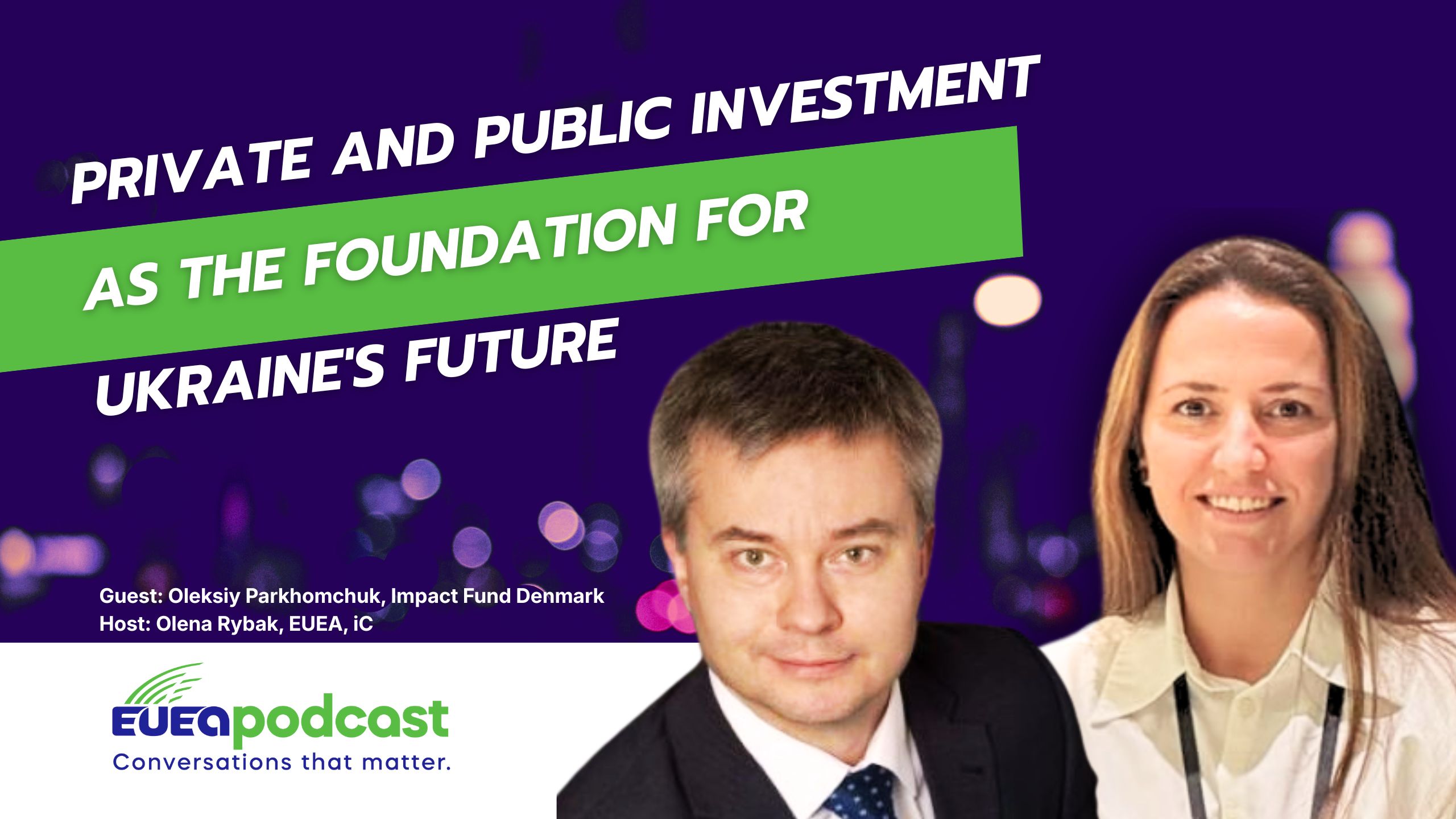
In this podcast, we speak to Oleksiy Parkhomchuk, Investment Director at Impact Fund Denmark.
The podcast is hosted by Olena Rybak, Deputy Chair of the European-Ukrainian Energy Agency and Managing Director of iC consulenten in Ukraine.
Oleksiy, your organisation operated for a long time under the name IFU — the Investment Fund for Developing Countries. Now it is Impact Fund Denmark. Why was the name changed?
— IFU has existed in Denmark since the 1960s and has been operating in Ukraine since the late 1990s. We became widely recognized under this name both in the Ukrainian market and in other Eastern European countries.
In June 2025, we changed our brand to emphasise our key focus: impact investments – investments that deliver a positive effect on both the private and public sectors. This includes job creation, support for vulnerable groups (in Ukraine, for example, veterans), and increasing companies’ profits and the state tax revenues.
Legally, we remain IFU for now, as changing the name of a state fund requires the Danish Parliament’s decision.
However, the brand name, Impact Fund Denmark, is already in use.
The fund is fully owned by the Danish state. How does this affect your activities?
— Denmark is a very entrepreneurial country by nature. Although the fund is state-owned, all investment decisions are made on a commercial basis. Our approach is clear: the investment must be returned at the end of its term, and the project must demonstrate real viability. An unsustainable model simply cannot be the subject of investment.
So, you don’t provide grants in Ukraine?
— We provided several grants to Ukraine in the public sector during the war. We also awarded several grants before the war. However, it is not our main activity. We can only make exceptions for the public sector and for countries experiencing difficulties, such as Ukraine is now facing.
We do not provide grants for the private sector. The only exception is microgrants for things like staff retraining or ESG training, exclusively to client companies with which we have established successful business cooperation.
Personally, I am very cautious about grants. This is because money at no cost often does not bring the expected result.
How long has the fund been operating in Ukraine?
— I don’t know the exact date, but it had launched its activities in Ukraine before I joined. I believe the first investment was made in 1997. The peak period of activity coincided with a period of Ukraine’s economic growth from 2006 to 2009 followed by the decline in 2014 – 2015. Since 2022, we have observed further decline, so we have changed our priorities and approaches.
In total, we work with more than 100 countries. Ukraine has always been one of our priorities, not just because of the war. Even before the war, we had a substantial projects portfolio here.
Despite all the crises in the Ukrainian economy — and these have been plentiful since 1997 — I am proud that our IRR (internal rate of return) has always been positive. It is not 20%, somewhere closer to 5–10%. Private investors and private investment funds in Ukraine achieve similar results.
Danish taxpayers’ money is put to good use under our stewardship, and we periodically return funds to the Danish budget in the form of dividends.
Could you elaborate on your projects in the private sector in Ukraine?
We started with agricultural projects, as this is a highly efficient sector in Denmark. In particular, pig farming. Many Ukrainian pig-breeding companies are either Danish-owned or using Danish technology, including genetic material, equipment and feed supplements.
However, we are not currently making new investments in this sector in any country due to the high risks associated with African swine fever as well as environmental and humanitarian issues. However, if we do not invest, someone else will, possibly without proper control or consideration of environmental and social issues. Therefore, in my personal opinion, we might resume investment in this area of animal husbandry, as Danish farms in Ukraine perform very well. In fact, their performance is even higher than in Denmark.
If agriculture is to remain in the future strategy, in which areas are you investing now? Are these exclusively investments that require a component of ‘Danish’ technology?
— Since 2016, we can invest in projects without a Danish component, focusing instead on the global impact and commercial viability of these projects.
In Ukraine, we have invested in dairy farming, which is more complex than pig farming. Our portfolio also includes investments in metalworking and electronics. Another area of our focus is finance, including banking institutions and private investment funds. We can invest in other funds, and we have invested twice in Horizon Capital, for example.
Our private sector investment portfolio is well diversified and has achieved remarkable results. This is thanks to our careful selection of projects and commitment of our clients’ management teams.
How much have you invested in Ukraine?
— I cannot give exact figure because there are several ways to calculate it. One way is to calculate current exposure, i.e. the amount we could lose in the country at any given moment. In Ukraine, this figure is currently about €80 million. This is the amount we expect to receive from our fifteen projects in Ukraine’s private sector over time.
Do you both invest as an institutional investor and provide loans, or focus on one of these?
— We provide both loans and equity.
What is your preferred financing instrument in Ukraine?
— Senior debt – a senior loan secured within the project itself. This is our preferred mechanism. However, we can also provide equity financing.
Energy is a very prominent topic now. Do you invest in this sector?
— Yes, energy is one of our priorities, especially in recent years. Around 50% of our portfolio consists of renewable energy projects, such as wind and solar. Next year, we plan to actively seek similar projects — it could be wind again, or solar combined with energy storage systems.
Personally, I really like this area as it involves a lot of clear mathematical calculations.
Energy cooperation with Ukraine is very important for Denmark. The Danish Embassy in Ukraine has an advisor who deals exclusively with energy issues. The Energoatom scandal is painful for us because it makes it harder to “sell” investment opportunities in the energy sector to other investors and even within the fund (since we never invest more than 30% of a project’s total cost).
It also harms Ukraine because, one way or another, it needs to ‘sell’ investment opportunities too. Such lack of transparency, combined with arbitrary rule, makes it difficult. This is especially the case considering that Ukraine is not the only country in the world that needs help in crisis.
A promising development for Ukrainians in the energy sector corruption case lies in the facts of corruption being exposed by our national anti-corruption agencies and widely covered in the Ukrainian media, spreading widely on social media. This demonstrates the availability of Ukrainian institutions ready to fight corruption, and that society supports this effort.
In Ukraine, you often hear that there is no funding available for projects. On the other side, funds, lenders, and banks say there is money, but no clients. Which side of this debate are you on?
— There is a shortage of projects that are actually worth investing in. Moreover, there is a lack of money, compounded by a shortage of people able to work on projects on behalf of international investors in Ukraine. The Ukrainian market is neither the easiest nor the most attractive for investment, thus, top investors often look to other countries where they can earn more with fewer risks.
For our fund specifically, however, the situation is a bit easier. We have sufficient experience in Ukraine and understand our resources, including how much we can invest per year and how many people we have available. In the private sector, this equates to 2–3 investments per year, possibly 4. We can also identify these investments relatively quickly. According to statistics, we filter out most proposals — around 95% — and accept the remaining 5%.
A shortage of projects is natural; there is always a shortage of quality products.
Yet, why do so few projects pass the selection process? Is it due to the workforce crisis? Or is it because many of them have a long investment cycle — first the concept, then the feasibility study, then the loan application and due diligence? Is this the reason of shortage? Or are there other reasons?
— Partly, it is the reason. However, the main cause is the catastrophic shortage of qualified personnel. Until 2021, Ukraine demonstrated good progress in developing multiple sectors. Since 2022, however, we have been losing qualified people on the frontline, within the country, and due to emigration. It directly affects the quality of management and, in our context, the quality of investment project preparation. A company that was investable becomes non-investable. All companies complain that they lack qualified personnel.
Unfortunately, the workforce crisis will only aggravate and won’t be resolved with the end of the war. I don’t think we fully realise yet the scale and impact of this problem.
How do you insure against risks in Ukrainian projects, particularly the military, logistical and economic risks?
— We do not insure against most risks. As a governmental agency, we effectively take on the country’s risks, but we disregard them in our estimates. However, we still try to reduce their impact. We examine geographical position very carefully. For instance, we are unlikely to operate in the Dnipropetrovsk region, nor will we invest in Kharkiv or Sumy, as these areas fall outside our area of expertise. There are other financing programmes for investments in these regions, including Danish ones.
Besides, we are in contact with the international investment guarantee institutions like DFC and MIGA, but we have not yet reached any conclusions.
But it does not stop you from investing?
— No, it doesn’t. We still do our job and invest, but we are more careful: we look closely at the geography, the project’s business plan, and all the risks that can be realistically assessed.
What is your fund’s role in supporting Ukraine, particularly in the municipal sector?
— Our fund has a separate division called Public Infrastructure Finance. In Ukraine, it was previously known as Danida Business Finance, then Danida Sustainable Infrastructure Finance (DSIF). This division deals with investments in the public sector, mainly working with municipalities.
So Danida was a division of Impact Fund Denmark?
— Yes, for many years, specifically in the area of investment in the public sector. Danida’s humanitarian division operates within the Danish Ministry of Foreign Affairs.
We have made about 5-6 investments in the public sector in Ukraine. Three of them are grant programmes, the others are loans. For example, one of the loan programmes is being implemented through NEFCO and aims to modernize the heating system in Kremenchuk. We are also actively cooperating with NEFCO in Mykolaiv.
Why is Mykolaiv a priority for Denmark?
— Mykolaiv is a city of shipbuilders, and Denmark is historically a country of shipbuilders. The Danish Embassy in Ukraine has an office in Mykolaiv.
There, a team is constantly working on programmes in the public sector, especially on modernising the water supply system. Water is a big problem for the city, so we have contributed to financing this area. Moreover, we have a project in Lviv, with the Lviv water utility. Before the war, we tried to implement projects in Zaporizhzhia, but currently they are on hold.
So, you finance projects in critical infrastructure. Do you consider energy efficiency projects?
— Yes, this topic is of utmost importance for us. However, so far, we haven’t got a project that fully meets our criteria. We hope the one will appear in the near future.
Does the risk assessment for municipal lending differ from that for the private sector?
— Absolutely. The risks in the public sector are higher, and it is understandable. While we carefully check every element of a business plan in the private sector, such verifications are more difficult to carry out in the municipal projects. Therefore, our approach to checks in public sector is more flexible.
Has the quality of applications in the municipal sector changed?
— Yes. Before the war, applications submitted by municipal enterprises were sufficiently qualified and prepared with the understanding of the requirements and approaches of foreign investors. Now we often get applications in which the main motivation is to get money. They do not always take into account the return on investment or the project effectiveness. People expect that someone will simply provide funding and everything will be fine. Unfortunately, this brings us back to the situation we had 20 years ago.
What is the strategy of Impact Fund Denmark for the next 5-7 years?
— We plan to focus more on the public sector. The needs in this area are crucial during the war and will remain a priority after the war. We want to help the country and cooperate with municipalities. Most likely, the private and public sectors will become equally important areas of focus for our fund.
The fund’s office in Ukraine has now grown to three people, two Ukrainians and one Dane — Head of the Office Søren Møller. One of his work priorities is the development of financing in the public sector.
Let’s imagine that Ukraine has begun to rebuild and is moving forward rapidly. What is the dream ‘project’ you personally would like to implement?
— The ideal project for me is a private-public partnership, when the private sector and municipalities work together, and investors provide financial resources.
For example, it could be a project to modernize the heating system, or any other project that would make people’s lives more comfortable and encourage them to live and work in Ukraine.
These are exactly the projects that make you proud to have been involved in their realization.
Podcast is available for viewing at the following link