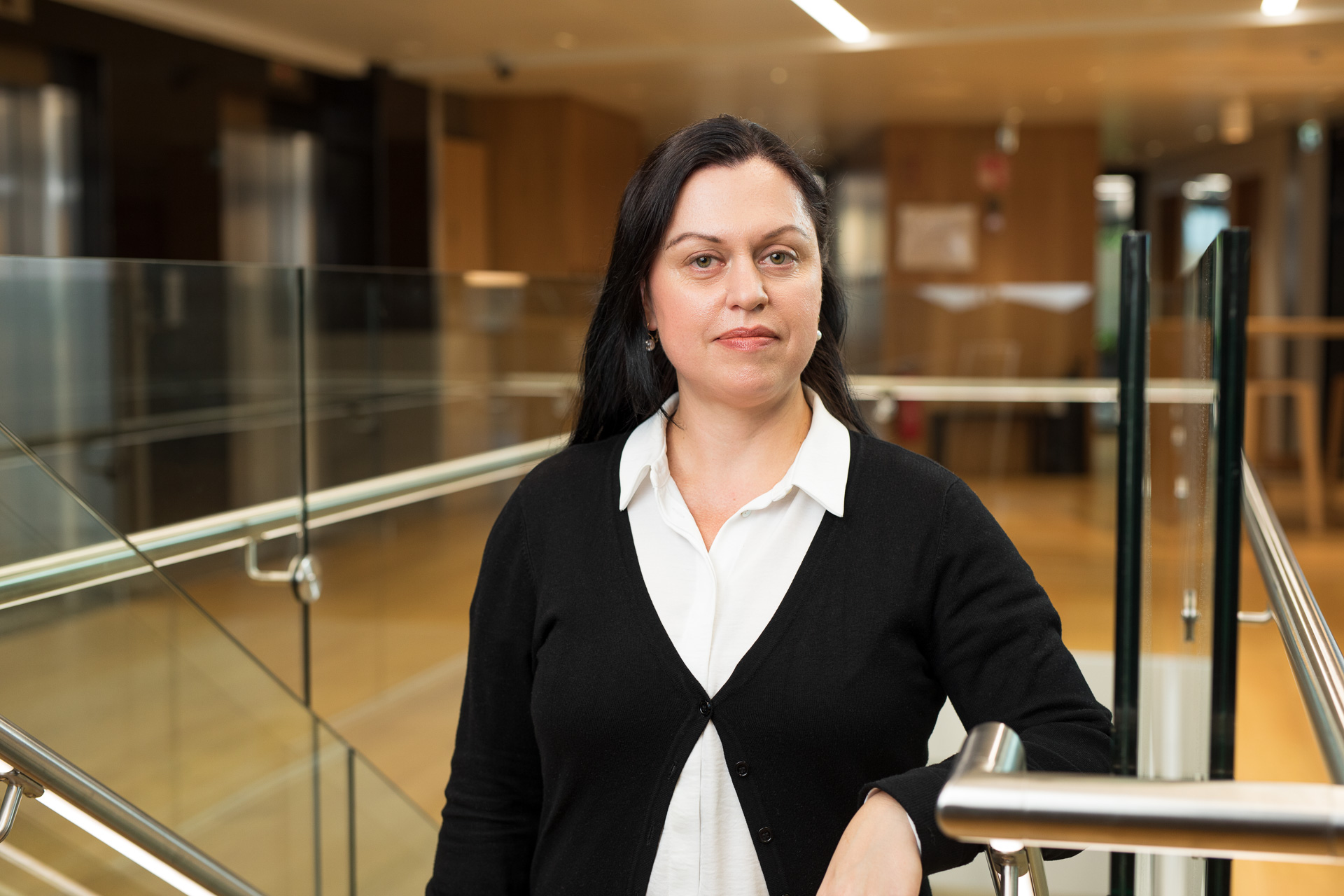
Interview with Yulia Shevchuk, Chief Investment Advisor at Nefco in Ukraine, specially for the European-Ukrainian Energy Agency
Yulia, since the beginning of the full-scale war in Ukraine, people, businesses, and state institutions have been divided into “before” and “after” life. Can you say the same about Nefco’s work in Ukraine? What changes have taken place?
We have a longstanding history in Ukraine and of course, we have changed along with the country. Before the war, Nefco in Ukraine worked mainly in the field of energy efficiency, with a portfolio dominated by renovation projects for public sector buildings. There were a lot of them – about 70 projects including daycare centres, schools, hospitals, and sports facilities. The financial resource – loans and grants – allowed us to carry out so many projects.
We also worked on energy efficiency in other areas, such as water supply, wastewater disposal, reconstruction of wastewater treatment plants, and heat supply. We focused on district heating, as our founding countries, such as Denmark and Sweden, believe that this is one of the most environmentally friendly and cost-effective infrastructure sectors. That is why we worked with those Ukrainian cities that still have centralised heat supply systems. These were mostly regional centres.
We are still continuing our reconstruction projects, but their direction has changed slightly.
Let’s move on to your “after.” Where exactly has the focus of Nefco’s activities in Ukraine shifted?
Like many people, when the war started, we took a short break to figure out where to go. But the pause was really short. Very soon, we were approached by representatives of the European Union with a proposal to repurpose existing programmes that were used for energy efficiency measures and allocate new funds to support Ukraine to strengthen the country’s ability to withstand Russia’s military aggression. Projects were launched to build and repair housing for internally displaced persons (IDPs) and critical infrastructure.
Long-term green recovery integrates Ukraine closer to Europe. In July 2022, we launched the Green Recovery Programme for Ukraine, which is a joint initiative with donors – the European Union and the governments of the Nordic countries. All our recovery projects have become part of this programme.
We redirected funds from the solid waste management programme, which was developed with EU funds, to repair housing for IDPs. The programme was intended for the purchase of equipment for cities, containers, bins, and work with landfills, etc. Since the waste programme was only midway through the process and no funds had been allocated yet, however, it could be completely reprofiled.
The programmes related to water and sewage have already been funded, so we did not change them. The cities in which they were implemented hosted many IDPs, so these projects were directly related to strengthening the capacity of cities to withstand military aggression. And we are continuing them.
Nefco is a fund manager for two new EU funded programs. The first one is the construction of housing for IDPs, which is a completely new area for Nefco, as we have never been involved in new construction projects. The EU has allocated EUR 100 million for it. And the second programme funded by the EU is the restoration of critical infrastructure in 12 communities in Kyiv region affected by the Russian occupation. Its budget is EUR 50 million.
How large is the housing construction program for IDPs?
New housing for IDPs is being built in nine cities. These are mostly regional centres in Western Ukraine, defined as cities that have received the largest number of IDPs. However, two small communities also participate in the programme.
The programme is divided into two components. The first one is funded through direct grant agreements between the European Union and the cities. And the second component is direct grant agreements between the cities and Nefco. Nefco is a fund manager for both components of the programme.
In addition to building housing for IDPs, public sector facilities are also being restored. For example, a new daycare centre is being built in Makariv to replace the one that was completely destroyed during the hostilities.
We held tenders and selected consultants to help cities implement these projects – SWECO and iC consulenten. Experienced consultants are a necessity in this programme, as communities on the ground need strong support – first of all, in organising the procurement of works according to Nefco rules, and on other issues. The pressure on the communities, already stretched before the war, has increased significantly, with the addition of humanitarian issues related to the need to provide decent conditions for IDPs.
At what stage are these projects now?
We have ambitious plans for the IDP Housing programme, which is to be completed in the first half of 2024. The normal project cycle for such construction is two years. But we realise that we don’t have that time now, and we need to build much faster than before the war.
We plan to shorten the construction cycle by performing some processes in parallel, where possible. Communities are currently developing design and estimate documentation. We expect the first set of documents for one of the cities to be ready soon. At the same time, we have already started prequalification, or the first stage of the tender. When the team of the programme learned about the scope of the project from the design and estimate documentation, they immediately started working on the second stage of the tender, the procurement of construction works.
Previously, the construction process was often delayed due to bureaucratic obstacles.
Unfortunately, the obstacles have not disappeared, and the process is quite difficult. So far, there has been no significant improvement and reduction of bureaucratic procedures throughout our project cycle. And we are trying to work within these existing conditions.
Let’s take construction, for example. The period for developing design and estimate documentation cannot be shortened because it involves the safety and quality of housing. But obtaining construction permits, the timeframe for passing the state expertise, the process of tax exemption, issuing bank guarantees for advance payments – all of these can be simplified.
It is clear that reform is a long process. But in order to receive external funding, the government needs to identify priority areas and urgently simplify procedures within them.
It doesn’t feel like you believe in this perspective.
My colleagues also ask me about it all the time, “Don’t you believe it?” (laughs).
It’s really hard to keep believing, because I’ve been working in this field for 15 years and I don’t see any significant changes.
But right now, my hope is growing stronger. I hope that life will force the state to change. Recently, I had to call the authorities about one such delay with documents. I asked them directly: “Do you want to rebuild the country or not? Then let’s get moving and stop demanding paper after paper».
I felt that I was understood there, and that my interlocutors really cared about the recovery projects. The employees responsible personally dealt with the procedural issues and convinced management that we needed to speed up. As a result, we received five registration documents in two days. This speed was unprecedented.
But of course, we would like to see systemic changes at the state level.
The new housing for IDPs that will be built is high-level social housing. In some respects, it is even better than social housing in some of our neighbouring EU countries. Why did you choose such a high standard for the project?
Building modern social housing in accordance with European standards was a requirement of the European Union at the start of the project. And we at Nefco strongly supported it.
We are already implementing the Build Back Better principle, which is declared in Ukraine. The energy efficiency standards for each of our projects are 10% higher than the Ukrainian ones. This is despite the fact that Ukrainian standards are well harmonised with European ones. In addition, each of our projects contains a green component. These can be solar panels, heat pumps or other measures that will contribute to the energy independence of both the facility and the country as a whole.
When it comes to housing, we make sure to set up green areas around our buildings, try to preserve every tree, and strictly adhere to inclusivity standards.
Is such a high bar for energy efficiency justified in a country at war? Perhaps it makes sense to reduce this percentage to speed up and simplify projects?
We had internal discussions about this at Nefco. As a Ukrainian, I was hesitant about it because a lot of people lost their homes entirely. They need to have at least basic houses, but here we are talking about green houses. And I understand the need to build faster.
However, calculations and consultations with our experts have proven that our ambitious energy efficiency goals can be achieved without extending the timeframe or increasing budgets. This is because we include them at the design stage.
Since your project is one of the first in Ukraine to build housing for IDPs, will it set the bar high for all the others? What do you think?
One of the indirect results of this project is the development of the construction market. During the procurement process, construction companies will be selected to work on construction projects in cities. I think that contractors will see from our projects with their own eyes that it is better to do quality projects according to high energy efficiency, environmental and inclusivity standards. Capacity building can be very important here.
We will do our best to train companies to work on European-level projects so that they can scale this up to Ukraine. But there is a big challenge here that only the state can solve. Ukraine is facing a critical situation with personnel in the construction market since military conscription is underway. Finding a balance between the need to defend the country and support the economy and continue recovery projects is not an easy task. But it will need to be resolved in the near future.
Capacity building should definitely be provided for the cities working in the project.
For all cities in our projects – both for housing repairs and construction, infrastructure rehabilitation and other projects – one of the main achievements, I think, will be the ability to work in a more efficient, horizontal structure.
Usually, cities are used to working in a rigid vertical structure. When they start working with us on a project, our main requirement is to create a project implementation unit. It consists of specialists from different departments that are horizontally linked: procurement, legal, financial, etc. And over time, they realise that everyone has an equal right to speak, their word matters, and everyone’s role is important.
Are you experiencing a shortage of financial instruments?
Currently, a lot of efforts by donors and international organisations are being spent on military support for Ukraine. The defence of the state is a priority. But reconstruction is also important. That is why we appreciate the fact that the European Union has launched a recovery programme in Ukraine.
We are currently negotiating with donors for future funding. First of all, we are talking about the financial content of our Green Recovery Fund. These are negotiations with our founders, the Nordic countries: Sweden, Denmark, Finland, Iceland, and Norway. We already have intentions and agreements with donors, and we are starting new recovery projects.
But in general, demand for recovery projects is huge in Ukraine. Every week we receive about five requests from Ukrainian cities. At Nefco, we are able to effectively and sustainably channel recovery funds. These cities want to work with us, but we could not cover all their needs. So far, we have made a portfolio of potential projects. If opportunities arise, we will definitely start working with cities, or rather, continue, because most of those who apply are already our partners with whom we have had successful projects in the past.
Communities are now very eager to cooperate. In the absence of grant resources, they are even ready to take out soft loans during wartime.
What are your plans for working in Ukraine? Are you optimistic or pessimistic about the future?
We have already started to rebuild Ukraine, and this is our main message to the country. The way that Nefco has historically implemented its projects – support and cooperation at the local community level – has proven to be the most effective. I think that the future lies with local communities, and the initiative will come from the bottom up. That is, all initiatives will be pushed by residents and community leaders to the state level. Otherwise, it will be very difficult.
This is the first time we have worked with rural communities in a critical infrastructure restoration project. At first, we had concerns about the effectiveness of cooperation, considering many of them were unfamiliar with projects at this scale. However, it turned out that these communities were remarkably receptive to cooperation, given their limited exposure to investment programmes.
In addition to the Green Recovery of Ukraine, we plan to cooperate with other funds. For example, Norway has very ambitious plans for Ukraine, with funding worth billions of euros. Nefco hopes to be part of this programme as an implementing agency.
Projects to build housing for IDPs and critical infrastructure can also be scaled up.